
Free Dumps, Free Microsoft Dump
Free AZ-104 Dump
Question #24Topic 6
HOTSPOT –
You have an Azure subscription that contains the resources shown in the following table.
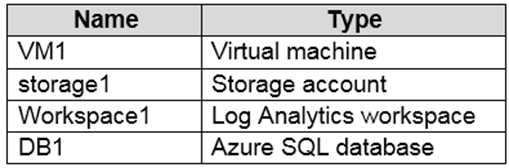
You plan to create a data collection rule named DCR1 in Azure Monitor.
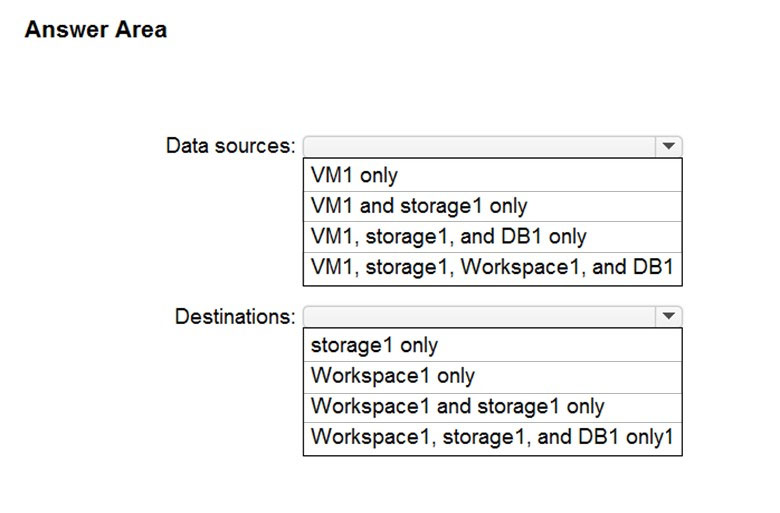
Which resources can you set as data sources in DCR1, and which resources can you set as destinations in DCR1? To answer, select the appropriate options in the answer area.
NOTE: Each correct selection is worth one point.
Hot Area:
Correct Answer: 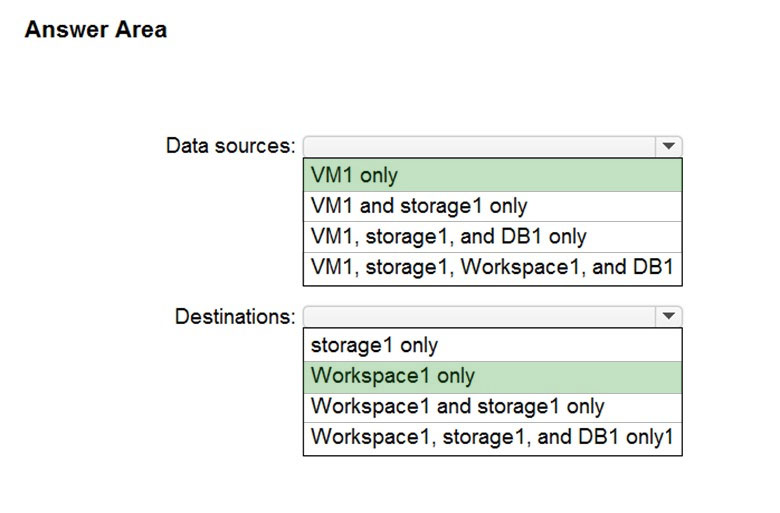
Box 1: VM1 only –
A virtual machine may have an association to multiple DCRs, and a DCR may have multiple virtual machines associated to it.
In the Resources tab, add the resources (virtual machines, virtual machine scale sets, Arc for servers) that should have the Data Collection Rule applied.
Box 2: Workspace1 only –
On the Destination tab, add one or more destinations for the data source. You can select multiple destinations of same of different types, for instance multiple Log
Analytics workspaces (i.e. “multi-homing”).
Note: The Data Collection Rules (or DCR) improve on a few key areas of data collection from VMs including like better control and scoping of data collection (e.g. collect from a subset of VMs for a single workspace), collect once and send to both Log Analytics and Azure Monitor Metrics, send to multiple workspaces (multi- homing for Linux), improved Windows event filtering, and improved extension management.
Reference:
https://docs.microsoft.com/en-us/azure/azure-monitor/agents/data-collection-rule-azure-monitor-agent
Question #25Topic 6
HOTSPOT –
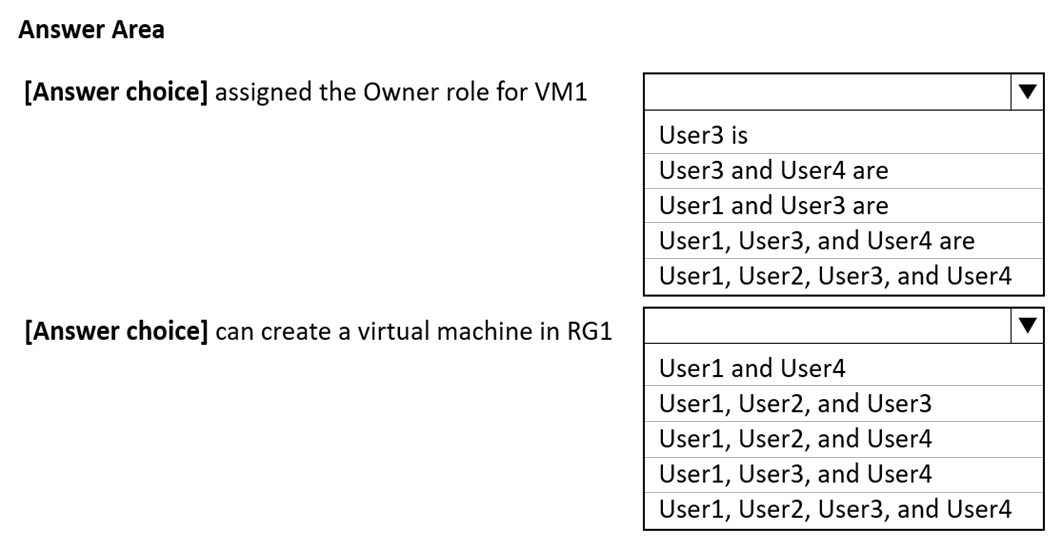
You have the role assignment file shown in the following exhibit.
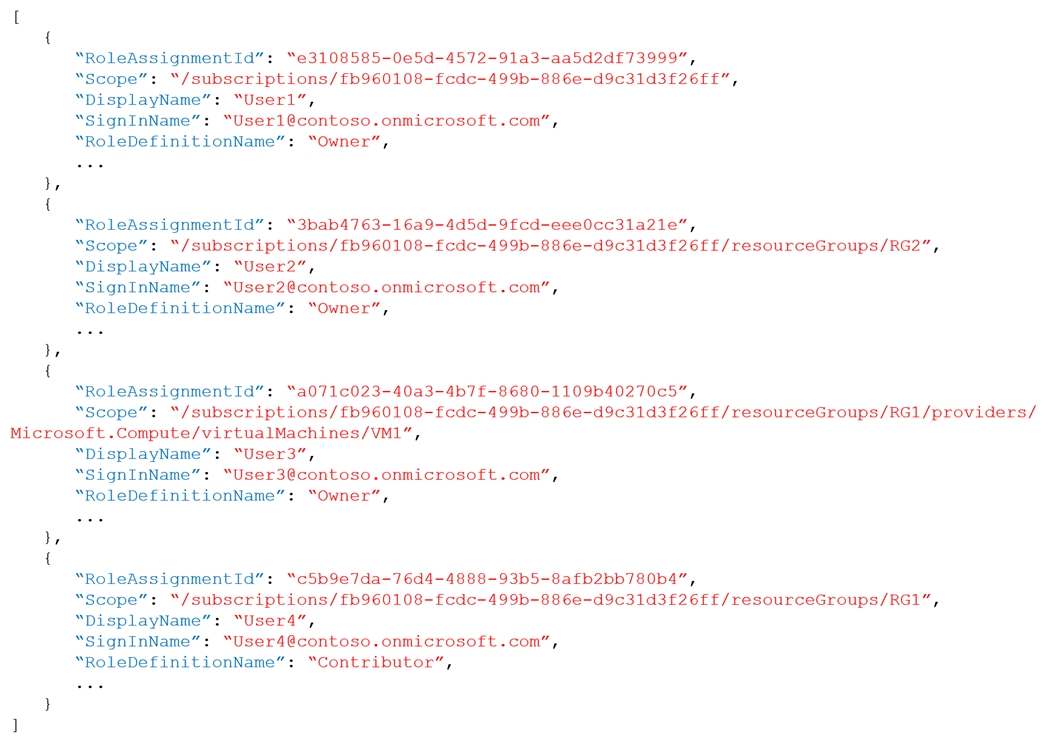
Use the drop-down menus to select the answer choice that completes each statement based on the information presented in the graphic.
NOTE: Each correct selection is worth one point.
Hot Area:
Correct Answer: 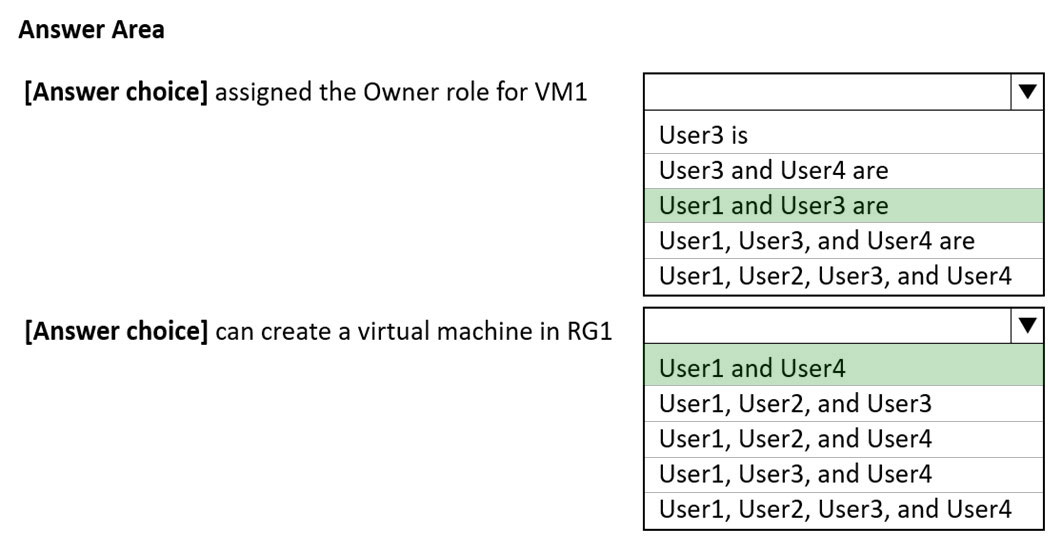
Question #26Topic 6
HOTSPOT –
You have the following custom role-based access control (RBAC) role.
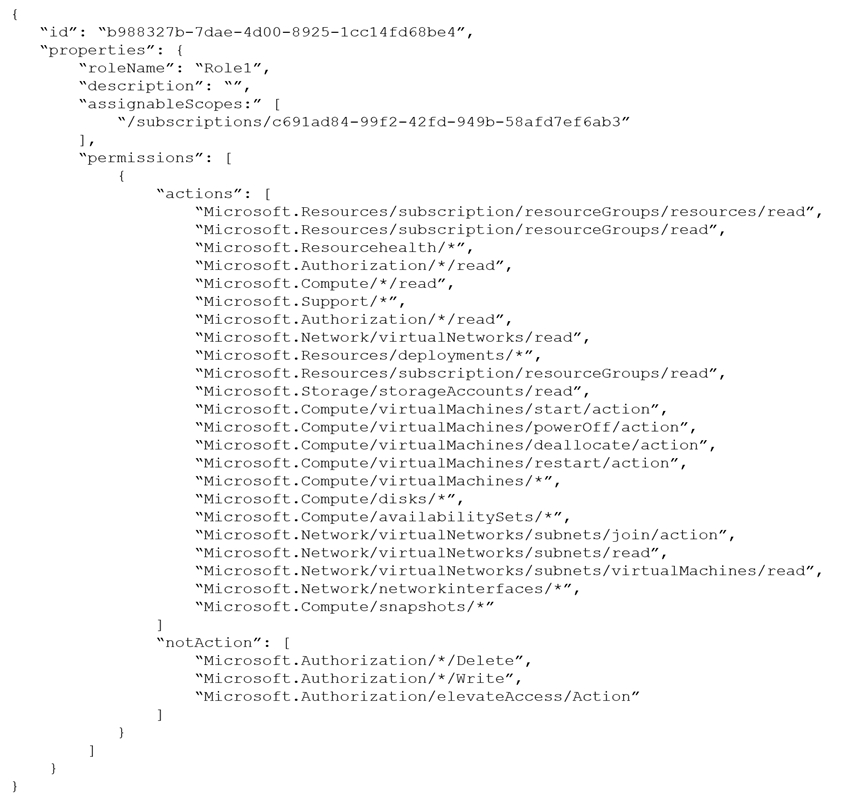
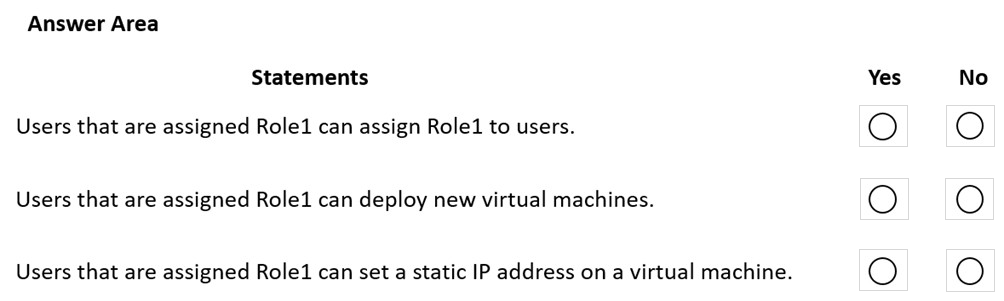
For each of the following statements, select Yes if the statement is true. Otherwise, select No.
NOTE: Each correct selection is worth one point.
Hot Area:
Correct Answer: 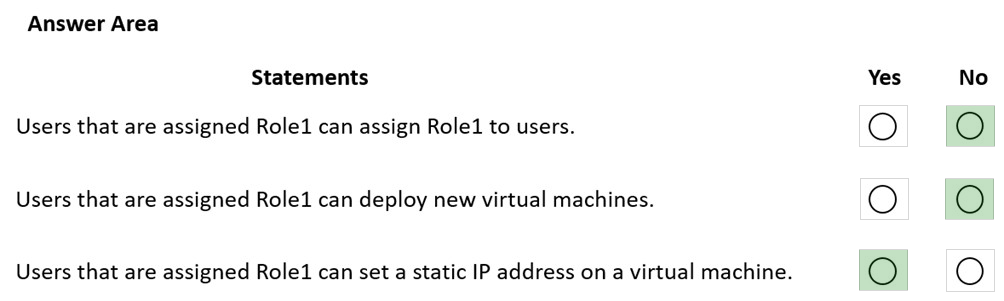
Question #27Topic 6
HOTSPOT –
You have an Azure subscription that contains the resources shown in the following table.
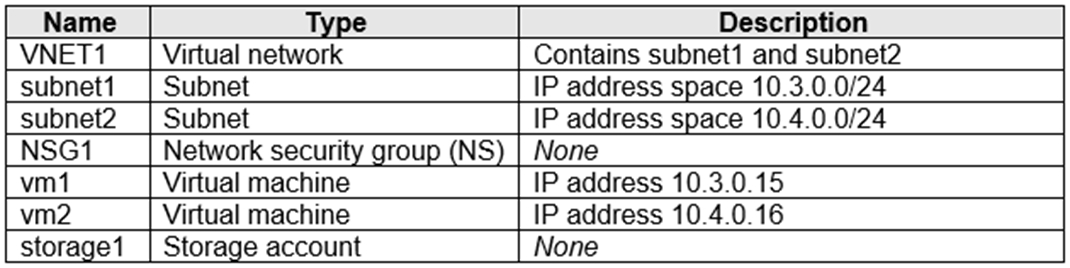
NSG1 is configured as shown in the following exhibit.
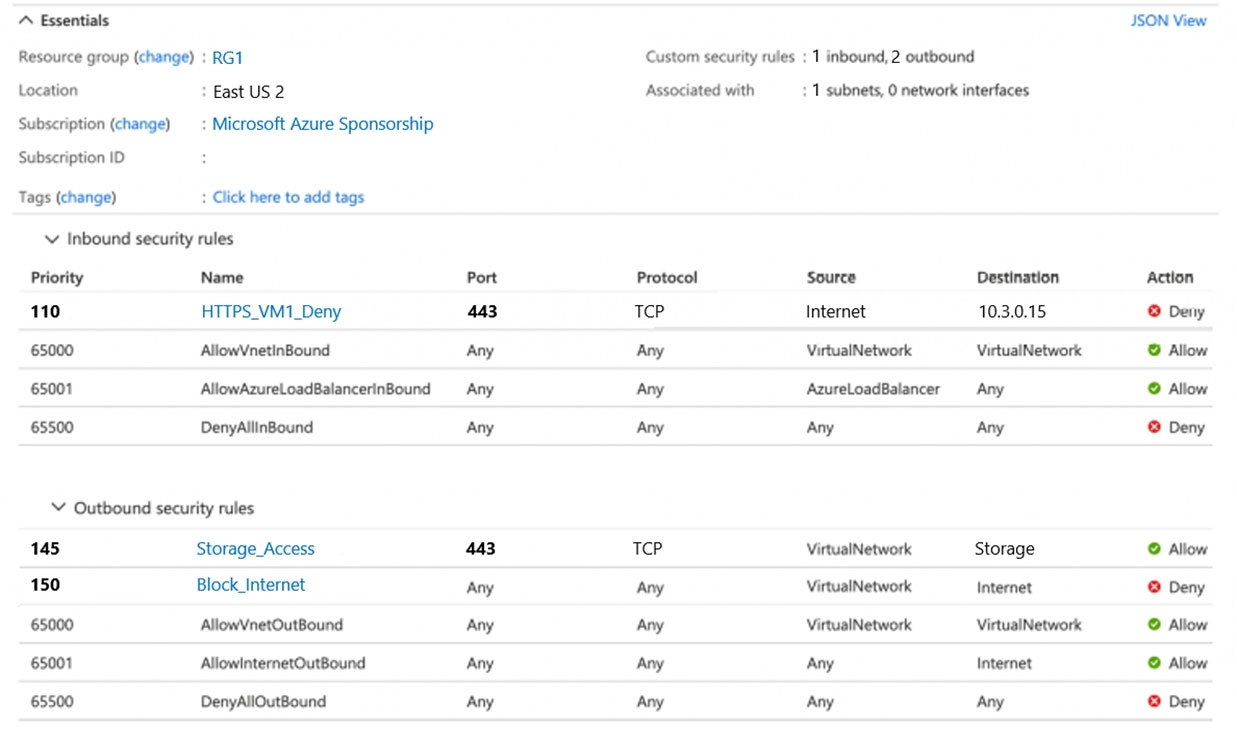
For each of the following statements, select Yes if the statement is true. Otherwise, select No.
NOTE: Each correct selection is worth one point.
Hot Area:
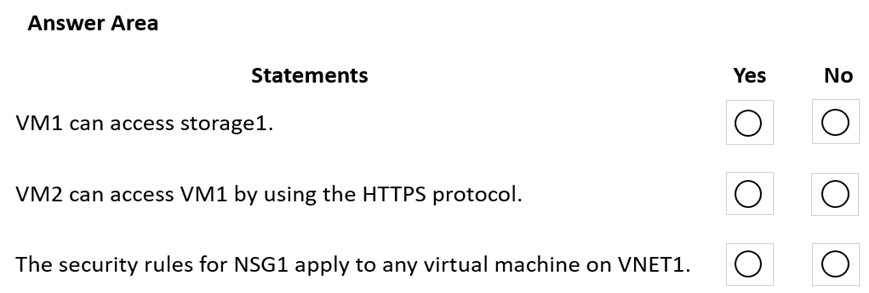
Correct Answer: 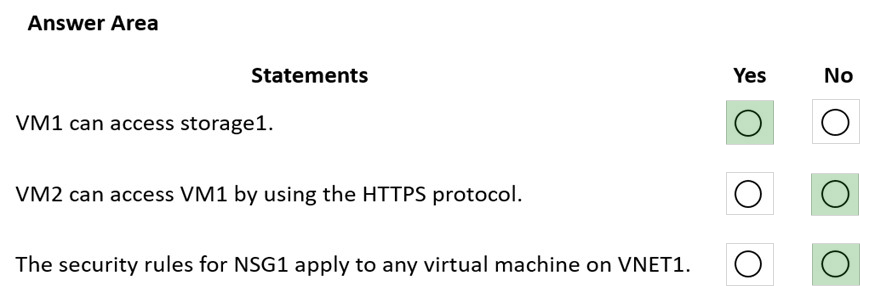
Question #28Topic 6
You have an Azure subscription named Subscription1 that contains two Azure virtual networks named VNet1 and VNet2. VNet1 contains a VPN gateway named
VPNGW1 that uses static routing. There is a site-to-site VPN connection between your on-premises network and VNet1.
On a computer named Client1 that runs Windows 10, you configure a point-to-site VPN connection to VNet1.
You configure virtual network peering between VNet1 and VNet2. You verify that you can connect to VNet2 from the on-premises network. Client1 is unable to connect to VNet2.
You need to ensure that you can connect Client1 to VNet2.
What should you do?
- A. Select Use the remote virtual network’s gateway or Route Server on VNet1 to VNet2 peering.
- B. Select Use the remote virtual network s gateway or Route Server on VNet2 to VNet1 peering.
- C. Download and re-install the VPN client configuration package on Client1.
- D. Enable BGP on VPNGW1.
Correct Answer: C
Community vote distribution
C (100%)
Question #29Topic 6
HOTSPOT –
You have two Azure subscriptions named Sub1 and Sub2. Sub1 is in a management group named MG1. Sub2 is in a management group named MG2.
You have the resource groups shown in the following table.
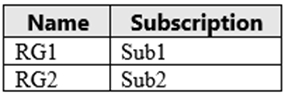
You have the virtual machines shown in the following table.
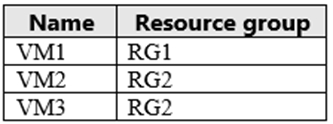
You assign roles to users as shown in the following table.
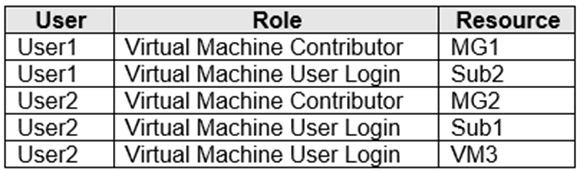
For each of the following statements, select Yes if the statement is true. Otherwise, select No.
NOTE: Each correct selection is worth one point.
Hot Area:
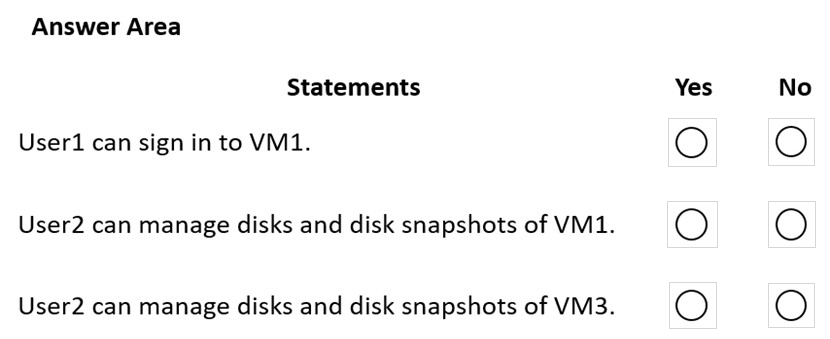
Correct Answer: 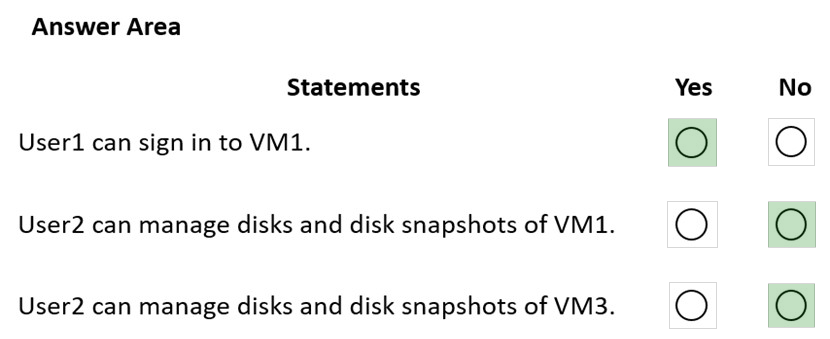
Question #30Topic 6
You have an Azure Active Directory (Azure AD) tenant that is linked to 10 Azure subscriptions.
You need to centrally monitor user activity across all the subscriptions.
What should you use?
- A. Azure Application Insights Profiler
- B. access reviews
- C. Activity log filters
- D. a Log Analytics workspace
Correct Answer: D
Community vote distribution
D (100%)
Question #31Topic 6
DRAG DROP –
You have an Azure subscription that contains a virtual machine name VM1.
VM1 has an operating system disk named Disk1 and a data disk named Disk2.
You need to back up Disk2 by using Azure Backup.
Which three actions should you perform in sequence? To answer, move the appropriate actions from the list of actions to the answer area and arrange them in the correct order.
Select and Place:
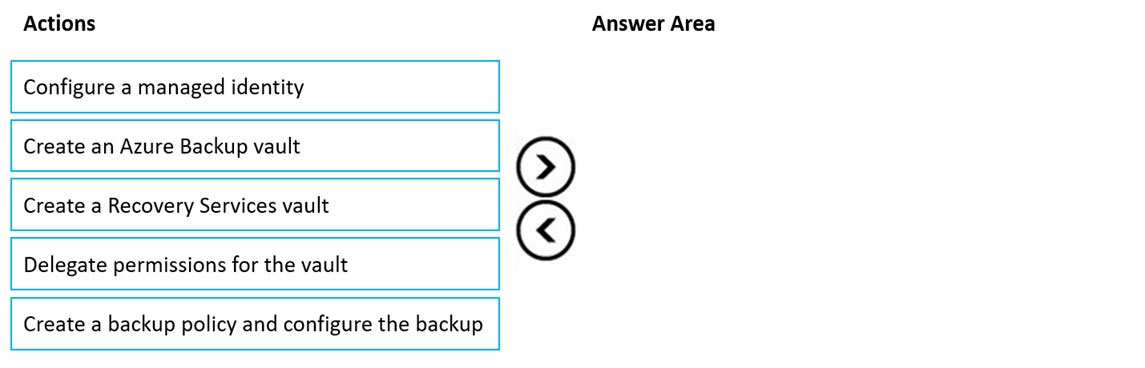
Correct Answer: 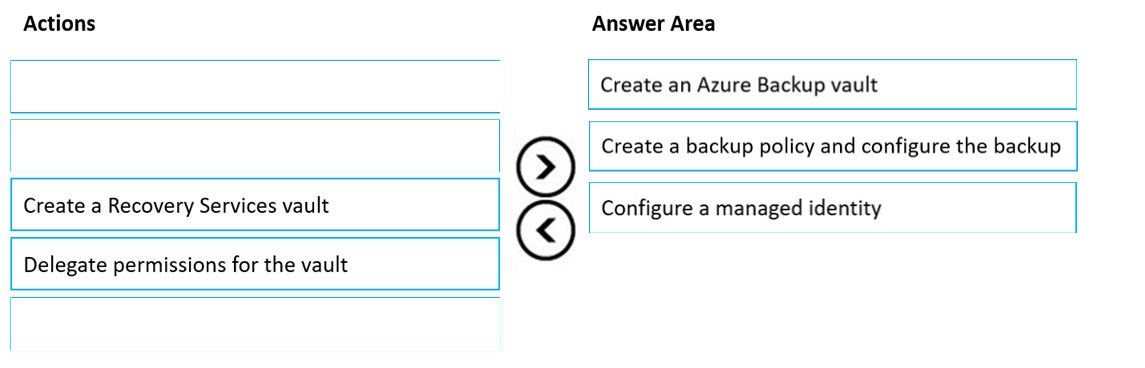
Question #32Topic 6
You have a subnet named Subnet1 that contains Azure virtual machines. A network security group (NSG) named NSG1 is associated to Subnet1. NSG1 only contains the default rules.
You need to create a rule in NSG1 to prevent the hosts on Subnet1 form connecting to the Azure portal. The hosts must be able to connect to other internet hosts.
To what should you set Destination in the rule?
- A. Application security group
- B. IP Addresses
- C. Service Tag
- D. Any
Correct Answer: C
Community vote distribution
C (100%)
Question #33Topic 6
You have an Azure subscription named Subscription1 that contains an Azure Log Analytics workspace named Workspace1.
You need to view the error events from a table named Event.
Which query should you run in Workspace1?
- A. search in (Event) “error”
- B. Event | where EventType is “error”
- C. select * from Event where EventType == “error”
- D. Get-Event Event | where {$_.EventType == “error”}
Correct Answer: A
Community vote distribution
A (87%)
13%
Question #34Topic 6
You have an Azure App Service web app named App1.
You need to collect performance traces for App1.
What should you use?
- A. Azure Application Insights Profiler
- B. the Activity log
- C. the Deployment center
- D. the Diagnose and solve problems settings
Correct Answer: B
Community vote distribution
A (100%)
Question #35Topic 6
You have an Azure subscription that contains the storage accounts shown in the following table.
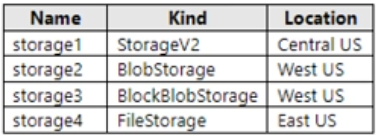
You deploy a web app named App1 to the West US Azure region.
You need to back up App1. The solution must minimize costs.
Which storage account should you use as the target for the backup?
- A. storage1
- B. storage2
- C. storage3
- D. storage4
Correct Answer: D
Community vote distribution
B (81%)
A (19%)
Question #36Topic 6
HOTSPOT
–
You have an Azure subscription that is linked to an Azure AD tenant. The tenant contains two users named User1 and User2.
The subscription contains the resources shown in the following table.

The subscription contains the alert rules shown in the following table.
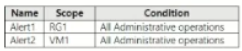
The users perform the following action:
• User1 creates a new virtual disk and attaches the disk to VM1
• User2 creates a new resource tag and assigns the tag to RG1 and VM1
Which alert rules are triggered by each user? To answer, select the appropriate options in the answer area.
NOTE: Each correct selection is worth one point.
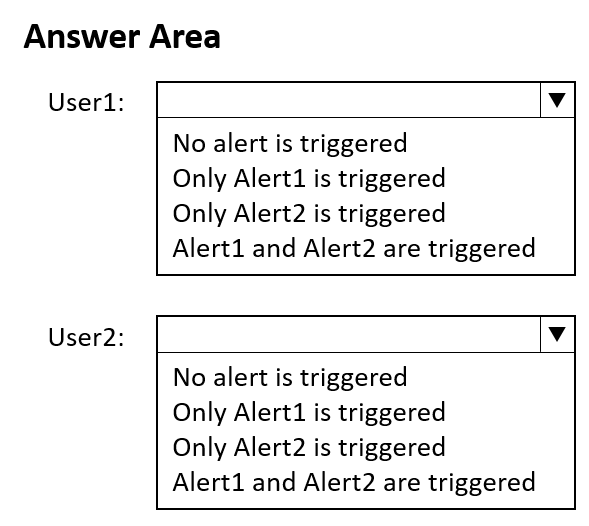
Correct Answer: 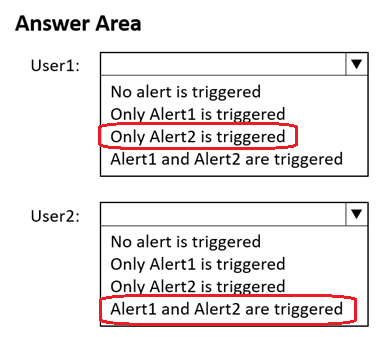
Question #37Topic 6
You plan to deploy several Azure virtual machines that will run Windows Server 2019 in a virtual machine scale set by using an Azure Resource Manager template.
You need to ensure that NGINX is available on all the virtual machines after they are deployed.
What should you use?
- A. a Desired State Configuration (DSC) extension
- B. the New-AzConfigurationAssignment cmdlet
- C. Azure Application Insights
- D. a Microsoft Endpoint Manager device configuration profile
Correct Answer: A
Community vote distribution
A (100%)
Question #38Topic 6
You have an Azure subscription that contains eight virtual machines and the resources shown in the following table.
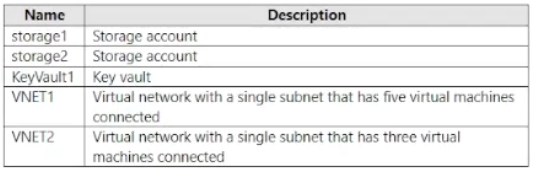
You need to configure access for VNET1. The solution must meet the following requirements:
• The virtual machines connected to VNET1 must be able to communicate with the virtual machines connected to VNET2 by using the Microsoft backbone.
• The virtual machines connected to VNET1 must be able to access storage1, storage2, and Azure AD by using the Microsoft backbone.
What is the minimum number of service endpoints you should add to VNET1?
- A. 1
- B. 2
- C. 3
- D. 5
Correct Answer: D
Community vote distribution
B (96%)
4%
Question #39Topic 6
You need to configure an Azure web app named contoso.azurewebsites.net to host www.contoso.com.
What should you do first?
- A. Create A records named www.contoso.com and asuid.contoso.com.
- B. Create a TXT record named asuid that contains the domain verification ID.
- C. Create a CNAME record named asuid that contains the domain verification ID.
- D. Create a TXT record named www.contoso.com that has a value of contoso.azurewebsites.net.
Correct Answer: C
Community vote distribution
B (65%)
C (21%)
10%
Question #40Topic 6
You have an Azure subscription that contains 10 network security groups (NSGs), 10 virtual machines, and a Log Analytics workspace named Workspace1. Each NSG is connected to a virtual machine.
You need to configure an Azure Monitor Network Insights alert that will be triggered when suspicious network traffic is detected.
What should you do first?
- A. Deploy Connection Monitor.
- B. Configure data collection endpoints.
- C. Configure a private link.
- D. Configure NSG flow logs.
Correct Answer: D
Community vote distribution
D (91%)
9%
Question #41Topic 6
HOTSPOT
–
You have an Azure subscription named Sub1 that contains the resources shown in the following table.

Sub1 contains the following alert rule:
• Name: Alert1
• Scope: All resource groups in Sub1
o Include all future resources
• Condition: All administrative operations
• Actions: Action1
Sub1 contains the following alert processing rule:
• Name: Rule1
• Scope: Sub1
• Rule type: Suppress notifications
• Apply the rule: On a specific time
o Start: August 10, 2022
o End: August 13, 2022
For each of the following statements, select Yes if the statement is true. Otherwise, select No.
NOTE: Each correct selection is worth one point.
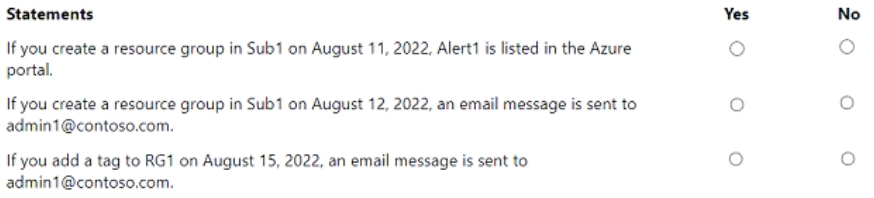
Correct Answer: 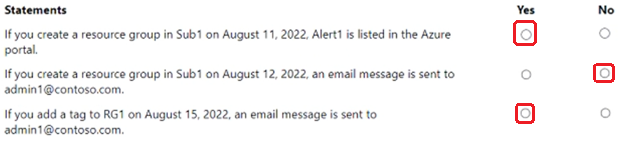
Question #42Topic 6
You have an Azure subscription that contains a storage account named storage1 in the North Europe Azure region.
You need to ensure that when blob data is added to storage1, a secondary copy is created in the East US region. The solution must minimize administrative effort.
What should you configure?
- A. operational backup
- B. object replication
- C. geo-redundant storage (GRS)
- D. a lifecycle management rule
Correct Answer: C
Community vote distribution
B (89%)
11%
Question #43Topic 6
You have an Azure subscription that contains two Log Analytics workspaces named Workspace1 and Workspace2 and 100 virtual machines that run Windows Server.
You need to collect performance data and events from the virtual machines. The solution must meet the following requirements:
• Logs must be sent to Workspace1 and Workspace 2.
• All Windows events must be captured.
• All security events must be captured.
What should you install and configure on each virtual machine?
- A. the Azure Monitor agent
- B. the Windows Azure diagnostics extension (WAD)
- C. the Windows VM agent
Correct Answer: A
Community vote distribution
A (100%)
Question #44Topic 6
You have an Azure subscription that contains a virtual machine named VM1 and an Azure function named App1.
You need to create an alert rule that will run App1 if VM1 stops.
What should you create for the alert rule?
- A. an application security group
- B. a security group that has dynamic device membership
- C. an action group
- D. an application group
Correct Answer: C
Community vote distribution
C (100%)
Question #45Topic 6
You have an Azure subscription that contains a virtual network named VNet1.
VNet1 uses two ExpressRoute circuits that connect to two separate on-premises datacenters.
You need to create a dashboard to display detailed metrics and a visual representation of the network topology.
What should you use?
- A. Azure Monitor Network Insights
- B. a Data Collection Rule (DCR)
- C. Azure Virtual Network Watcher
- D. Log Analytics
Correct Answer: A
Community vote distribution
A (86%)
14%
Question #46Topic 6
You deploy Azure virtual machines to three Azure regions
Each region contains a virtual network. Each virtual network contains multiple subnets peered in a full mesh topology.
Each subnet contains a network security group (NSG) that has defined rules.
A user reports that he cannot use port 33000 to connect from a virtual machine in one region to a virtual machine in another region.
Which two options can you use to diagnose the issue? Each correct answer presents a complete solution.
NOTE: Each correct selection is worth one point.
- A. Azure Virtual Network Manager
- B. IP flow verify
- C. Azure Monitor Network Insights
- D. Connection troubleshoot
- E. elective security rules
Correct Answer: BC
Community vote distribution
BD (100%)
Question #47Topic 6
You have an Azure subscription.
You need to receive an email alert when a resource lock is removed from any resource in the subscription.
What should you use to create an activity log alert in Azure Monitor?
- A. a resource, a condition, and an action group
- B. a resource, a condition, and a Microsoft 365 group
- C. a Log Analytics workspace, a resource, and an action group
- D. a data collection endpoint, an application security group, and a resource group
Correct Answer: A
Community vote distribution
A (100%)
Question #48Topic 6
HOTSPOT
–
You have an Azure subscription that contains the alerts shown in the following exhibit.
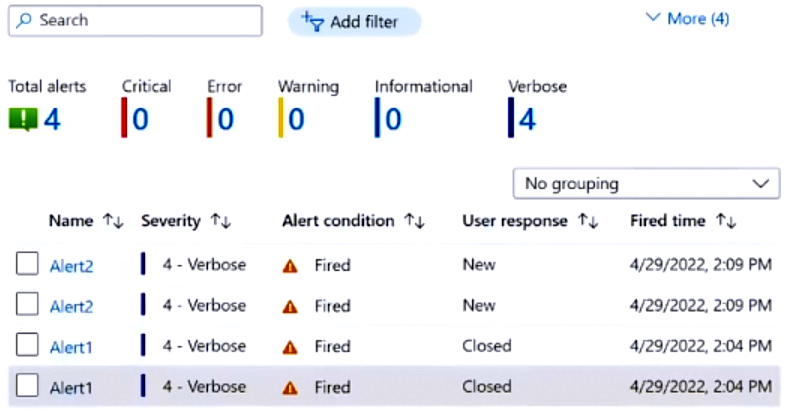
Use the drop-down menus to select the answer choice that completes each statement based on the information presented in the graphic.
NOTE: Each correct selection is worth one point.
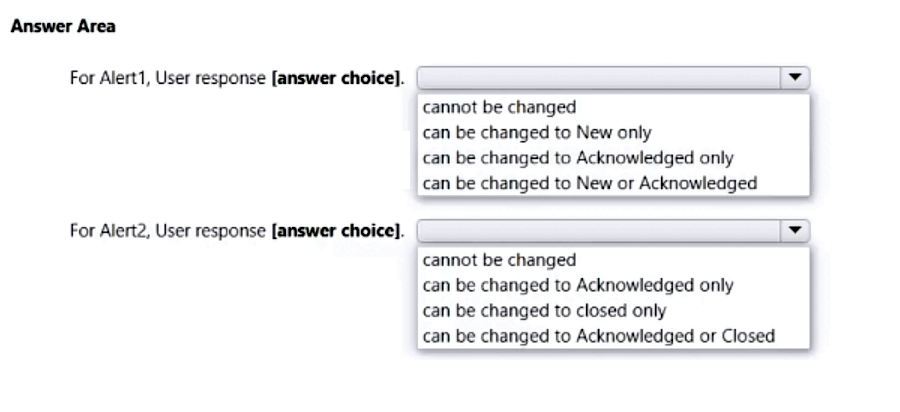
Correct Answer: 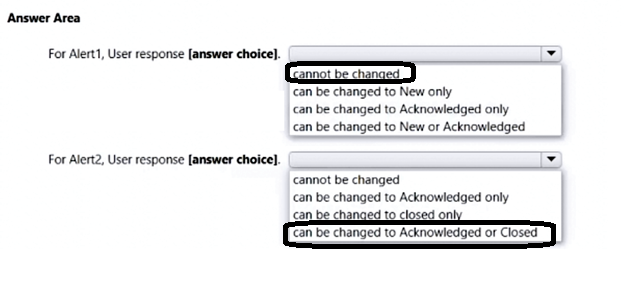
Question #49Topic 6
HOTSPOT
–
You create a Recovery Services vault backup policy named Policy1 as shown in the following exhibit:
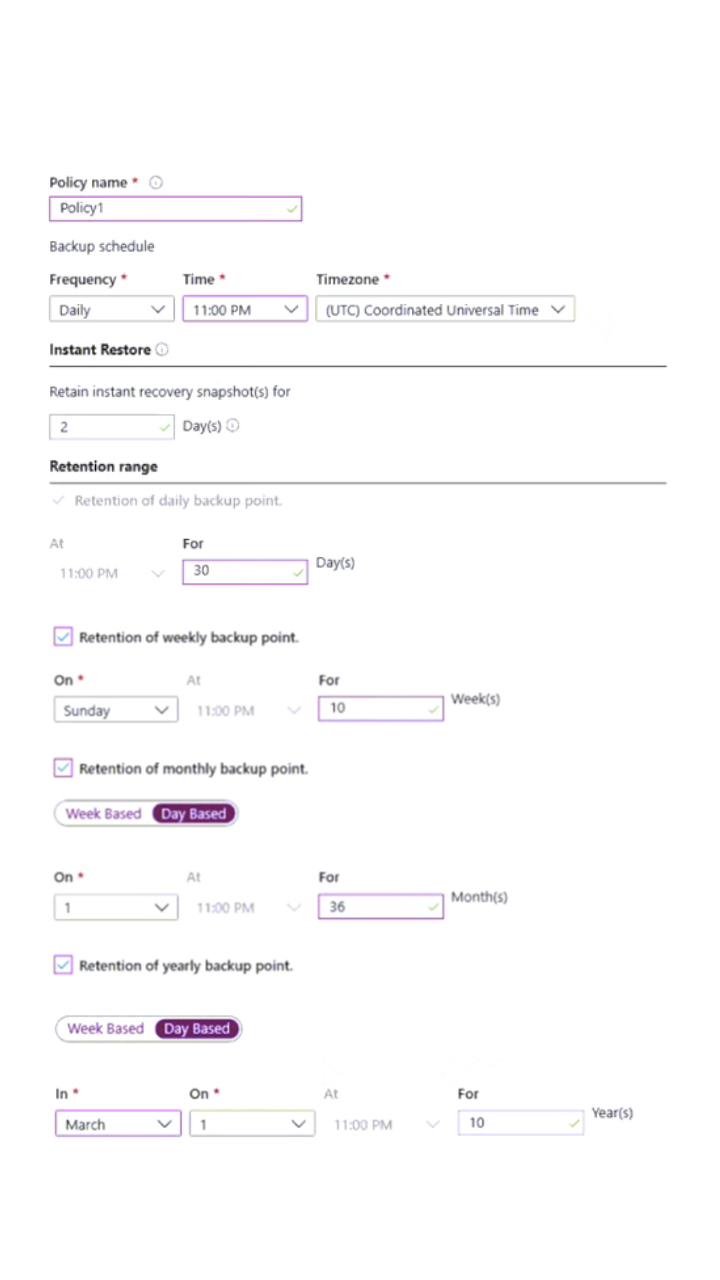
Use the drop-down menus to select the answer choice that completes each statement based on the information presented in the graphic.
NOTE: Each correct selection is worth one point.
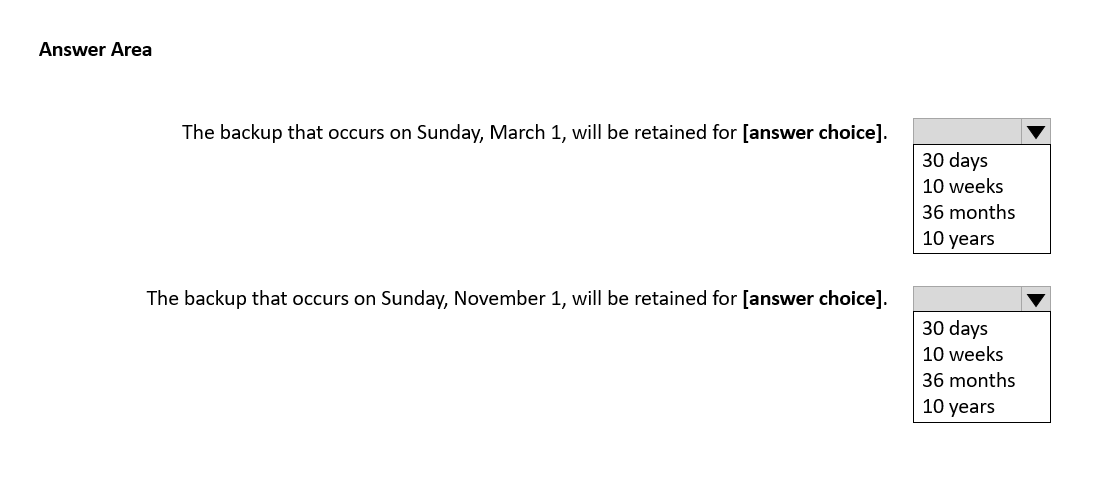
Correct Answer: 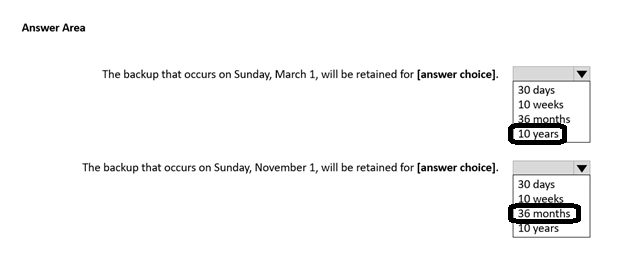
Question #50Topic 6
HOTSPOT
–
You have an Azure subscription that contains the vaults shown in the following table.
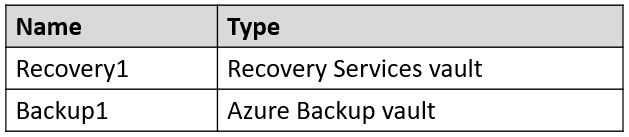
You deploy the virtual machines shown in the following table.
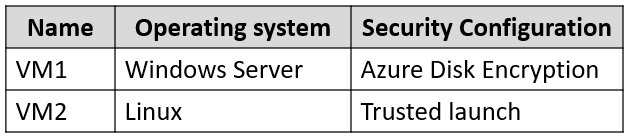
You have the backup policies shown in the following table.
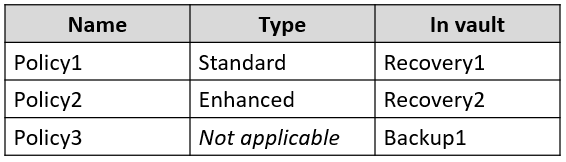
For each of the following statements, select Yes if the statement is true. Otherwise, select No.
NOTE: Each correct selection is worth one point.
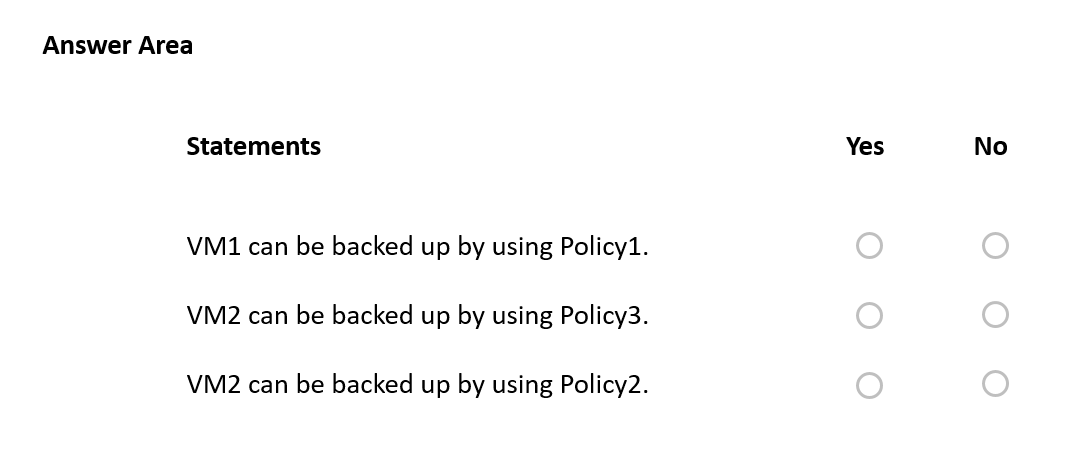
Correct Answer: 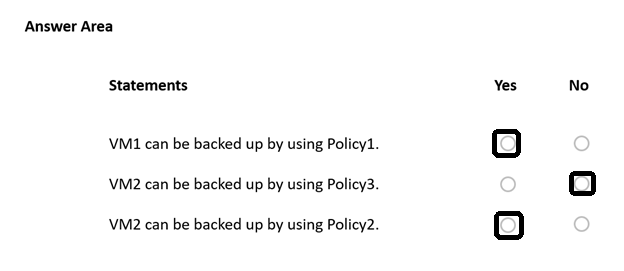
Question #51Topic 6
You have an Azure subscription. The subscription contains virtual machines that connect to a virtual network named VNet1.
You plan to configure Azure Monitor for VM Insights.
You need to ensure that all the virtual machines only communicate with Azure Monitor through VNet1.
What should you create first?
- A. a data collection rule (DCR)
- B. a Log Analytics workspace
- C. an Azure Monitor Private Link Scope (AMPLS)
- D. a private endpoint
Correct Answer: C
Community vote distribution
C (75%)
D (25%)
Question #52Topic 6
HOTSPOT
–
You have an Azure subscription that contains the vaults shown in the following table.
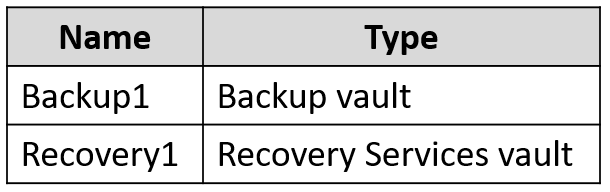
You create a storage account that contains the resources shown in the following table.
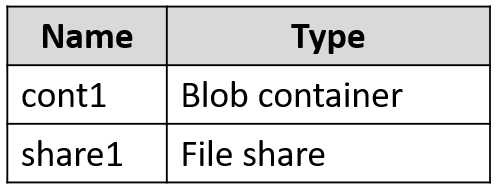
To which vault can you back up cont1 and share1? To answer, select the appropriate options in the answer area.
NOTE: Each correct answer is worth one point.
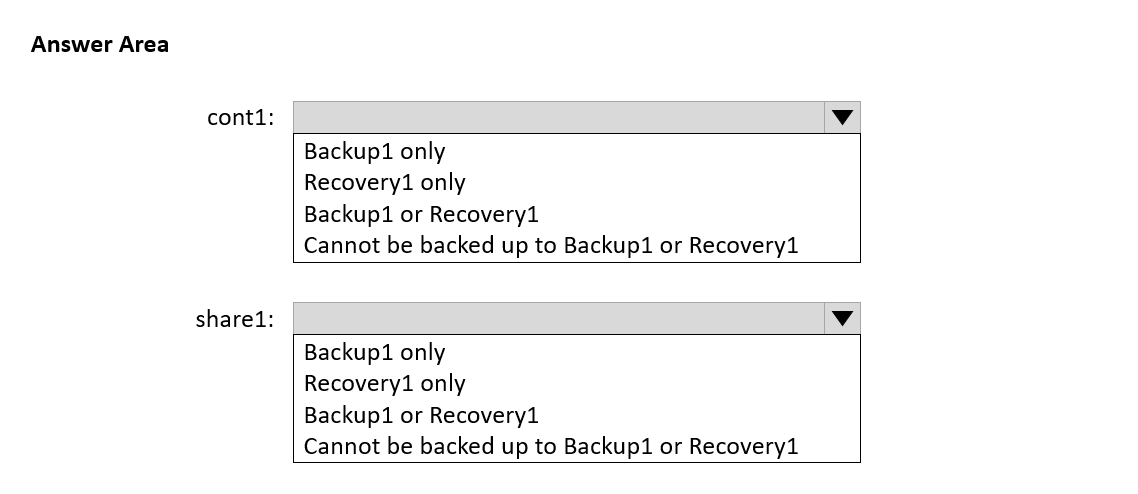
Correct Answer: 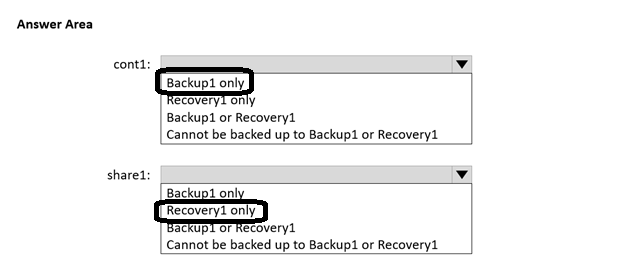
Question #53Topic 6
You have an Azure subscription that contains an Azure Stream Analytics job named Job1.
You need to monitor input events for Job1 to identify the number of events that were NOT processed.
Which metric should you use?
- A. Out-of-Order Events
- B. Output Events
- C. Late Input Events
- D. Backlogged Input Events
Correct Answer: D
Community vote distribution
D (100%)
Question #54Topic 6
You have an Azure subscription that contains an Azure SQL database named DB1.
You plan to use Azure Monitor to monitor the performance of DB1. You must be able to run queries to analyze log data.
Which destination should you configure in the Diagnostic settings of DB1?
- A. Send to a Log Analytics workspace.
- B. Archive to a storage account.
- C. Stream to an Azure event hub.
Correct Answer: A
Community vote distribution
A (100%)
Question #55Topic 6
You have an Azure subscription. The subscription contains virtual machines that run Windows Server.
You have a data collection rule (DCR) named Rule1.
You plan to use the Azure Monitor Agent to collect events from Windows System event logs.
You only need to collect system events that have an ID of 1001.
Which type of query should you use for the data source in Rule1?
- A. SQL
- B. XPath
- C. KQL
Correct Answer: B
Community vote distribution
B (67%)
C (33%)
Question #56Topic 6
You have an Azure subscription that contains a virtual machine named VM1.
You have an on-premises datacenter that contains a domain controller named DC1. ExpressRoute is used to connect the on-premises datacenter to Azure.
You need to use Connection Monitor to identify network latency between VM1 and DC1.
What should you install on DC1?
- A. the Azure Connected Machine agent for Azure Arc-enabled servers
- B. the Azure Network Watcher Agent virtual machine extension
- C. the Log Analytics agent
- D. an Azure Monitor agent extension
Correct Answer: D
Community vote distribution
D (100%)
Question #57Topic 6
You have an Azure subscription that has Traffic Analytics configured.
You deploy a new virtual machine named VM1 that has the following settings:
• Region: East US
• Virtual network: VNet1
• NIC network security group: NSG1
You need to monitor VM1 traffic by using Traffic Analytics.
Which settings should you configure?
- A. Diagnostic settings for VM1
- B. NSG flow logs for NSG1
- C. Diagnostic settings for NSG1
- D. Insights for VM1
Correct Answer: B
Question #58Topic 6
You have an Azure subscription. The subscription contains 10 virtual machines that run Windows Server. Each virtual machine hosts a website in IIS and has the Azure Monitor Agent installed.
You need to collect the IIS logs from each virtual machine and store them in a Log Analytics workspace.
What should you configure first?
- A. a data collection endpoint
- B. an Azure Monitor Private Link Scope (AMPLS)
- C. Diagnostic settings
- D. VM insights
- E. a private endpoint
Correct Answer: A
Topic 7 – Testlet 1
Question #1Topic 7
Introductory InfoCase study –
This is a case study. Case studies are not timed separately. You can use as much exam time as you would like to complete each case. However, there may be additional case studies and sections on this exam. You must manage your time to ensure that you are able to complete all questions included on this exam in the time provided.
To answer the questions included in a case study, you will need to reference information that is provided in the case study. Case studies might contain exhibits and other resources that provide more information about the scenario that is described in the case study. Each question is independent of the other questions in this case study.
At the end of this case study, a review screen will appear. This screen allows you to review your answers and to make changes before you move to the next section of the exam. After you begin a new section, you cannot return to this section.
To start the case study –
To display the first question in this case study, click the Next button. Use the buttons in the left pane to explore the content of the case study before you answer the questions. Clicking these buttons displays information such as business requirements, existing environment, and problem statements. If the case study has an All Information tab, note that the information displayed is identical to the information displayed on the subsequent tabs. When you are ready to answer a question, click the Question button to return to the question.
Overview –
Contoso, Ltd. is a manufacturing company that has offices worldwide. Contoso works with partner organizations to bring products to market.
Contoso products are manufactured by using blueprint files that the company authors and maintains.
Existing Environment –
Currently, Contoso uses multiple types of servers for business operations, including the following:
File servers
Domain controllers
Microsoft SQL Server servers
Your network contains an Active Directory forest named contoso.com. All servers and client computers are joined to Active Directory.
You have a public-facing application named App1. App1 is comprised of the following three tiers:
A SQL database
A web front end
A processing middle tier –

Each tier is comprised of five virtual machines. Users access the web front end by using HTTPS only.
Requirements –
Planned Changes –
Contoso plans to implement the following changes to the infrastructure:
Move all the tiers of App1 to Azure.
Move the existing product blueprint files to Azure Blob storage.
Create a hybrid directory to support an upcoming Microsoft 365 migration project.
Technical Requirements –
Contoso must meet the following technical requirements:
Move all the virtual machines for App1 to Azure.
Minimize the number of open ports between the App1 tiers.
Ensure that all the virtual machines for App1 are protected by backups.
Copy the blueprint files to Azure over the Internet.
Ensure that the blueprint files are stored in the archive storage tier.
Ensure that partner access to the blueprint files is secured and temporary.
Prevent user passwords or hashes of passwords from being stored in Azure.
Use unmanaged standard storage for the hard disks of the virtual machines.
Ensure that when users join devices to Azure Active Directory (Azure AD), the users use a mobile phone to verify their identity.
Minimize administrative effort whenever possible.
User Requirements –
Contoso identifies the following requirements for users:
Ensure that only users who are part of a group named Pilot can join devices to Azure AD.
Designate a new user named Admin1 as the service admin for the Azure subscription.
Admin1 must receive email alerts regarding service outages.
Ensure that a new user named User3 can create network objects for the Azure subscription.QuestionHOTSPOT –
You need to configure the Device settings to meet the technical requirements and the user requirements.
Which two settings should you modify? To answer, select the appropriate settings in the answer area.
Hot Area:
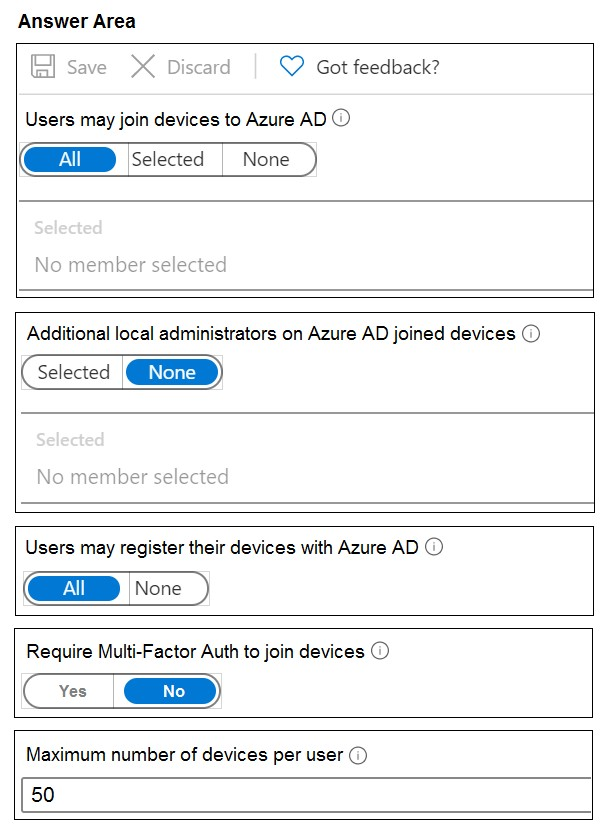
Correct Answer: 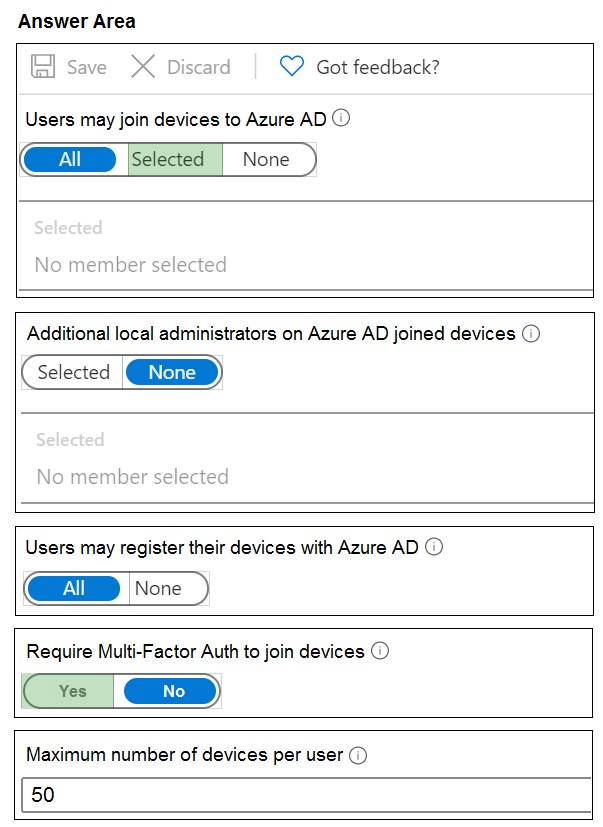
Box 1: Selected –
Only selected users should be able to join devices
Box 2: Yes –
Ensure that when users join devices to Azure Active Directory (Azure AD), the users use a mobile phone to verify their identity.
Question #2Topic 7
Introductory InfoCase study –
This is a case study. Case studies are not timed separately. You can use as much exam time as you would like to complete each case. However, there may be additional case studies and sections on this exam. You must manage your time to ensure that you are able to complete all questions included on this exam in the time provided.
To answer the questions included in a case study, you will need to reference information that is provided in the case study. Case studies might contain exhibits and other resources that provide more information about the scenario that is described in the case study. Each question is independent of the other questions in this case study.
At the end of this case study, a review screen will appear. This screen allows you to review your answers and to make changes before you move to the next section of the exam. After you begin a new section, you cannot return to this section.
To start the case study –
To display the first question in this case study, click the Next button. Use the buttons in the left pane to explore the content of the case study before you answer the questions. Clicking these buttons displays information such as business requirements, existing environment, and problem statements. If the case study has an All Information tab, note that the information displayed is identical to the information displayed on the subsequent tabs. When you are ready to answer a question, click the Question button to return to the question.
Overview –
Contoso, Ltd. is a manufacturing company that has offices worldwide. Contoso works with partner organizations to bring products to market.
Contoso products are manufactured by using blueprint files that the company authors and maintains.
Existing Environment –
Currently, Contoso uses multiple types of servers for business operations, including the following:
File servers
Domain controllers
Microsoft SQL Server servers
Your network contains an Active Directory forest named contoso.com. All servers and client computers are joined to Active Directory.
You have a public-facing application named App1. App1 is comprised of the following three tiers:
A SQL database
A web front end
A processing middle tier –

Each tier is comprised of five virtual machines. Users access the web front end by using HTTPS only.
Requirements –
Planned Changes –
Contoso plans to implement the following changes to the infrastructure:
Move all the tiers of App1 to Azure.
Move the existing product blueprint files to Azure Blob storage.
Create a hybrid directory to support an upcoming Microsoft 365 migration project.
Technical Requirements –
Contoso must meet the following technical requirements:
Move all the virtual machines for App1 to Azure.
Minimize the number of open ports between the App1 tiers.
Ensure that all the virtual machines for App1 are protected by backups.
Copy the blueprint files to Azure over the Internet.
Ensure that the blueprint files are stored in the archive storage tier.
Ensure that partner access to the blueprint files is secured and temporary.
Prevent user passwords or hashes of passwords from being stored in Azure.
Use unmanaged standard storage for the hard disks of the virtual machines.
Ensure that when users join devices to Azure Active Directory (Azure AD), the users use a mobile phone to verify their identity.
Minimize administrative effort whenever possible.
User Requirements –
Contoso identifies the following requirements for users:
Ensure that only users who are part of a group named Pilot can join devices to Azure AD.
Designate a new user named Admin1 as the service admin for the Azure subscription.
Admin1 must receive email alerts regarding service outages.
Ensure that a new user named User3 can create network objects for the Azure subscription.QuestionYou need to meet the user requirement for Admin1.
What should you do?
- A. From the Azure Active Directory blade, modify the Groups
- B. From the Azure Active Directory blade, modify the Properties
- C. From the Subscriptions blade, select the subscription, and then modify the Access control (IAM) settings
- D. From the Subscriptions blade, select the subscription, and then modify the Properties
Correct Answer: D
Scenario:
✑ Designate a new user named Admin1 as the service admin for the Azure subscription.
✑ Admin1 must receive email alerts regarding service outages.
Follow these steps to change the Service Administrator in the Azure portal.
1. Make sure your scenario is supported by checking the limitations for changing the Service Administrator.
2. Sign in to the Azure portal as the Account Administrator.
3. Open Cost Management + Billing and select a subscription.
4. In the left navigation, click Properties.
5. Click Service Admin.
Reference:
https://docs.microsoft.com/en-us/azure/role-based-access-control/classic-administrators
Community vote distribution
D (57%)
C (43%)
Topic 8 – Testlet 10
Question #1Topic 8
Introductory InfoCase study –
This is a case study. Case studies are not timed separately. You can use as much exam time as you would like to complete each case. However, there may be additional case studies and sections on this exam. You must manage your time to ensure that you are able to complete all questions included on this exam in the time provided.
To answer the questions included in a case study, you will need to reference information that is provided in the case study. Case studies might contain exhibits and other resources that provide more information about the scenario that is described in the case study. Each question is independent of the other questions in this case study.
At the end of this case study, a review screen will appear. This screen allows you to review your answers and to make changes before you move to the next section of the exam. After you begin a new section, you cannot return to this section.
To start the case study –
To display the first question in this case study, click the Next button. Use the buttons in the left pane to explore the content of the case study before you answer the questions. Clicking these buttons displays information such as business requirements, existing environment, and problem statements. If the case study has an All Information tab, note that the information displayed is identical to the information displayed on the subsequent tabs. When you are ready to answer a question, click the Question button to return to the question.
Overview –
General Overview –
Contoso, Ltd. is a consulting company that has a main office in Montreal and branch offices in Seattle and New York.
Environment –
Existing Environment –
Contoso has an Azure subscription named Sub1 that is linked to an Azure Active Directory (Azure AD) tenant. The network contains an on-premises Active
Directory domain that syncs to the Azure AD tenant.
The Azure AD tenant contains the users shown in the following table.
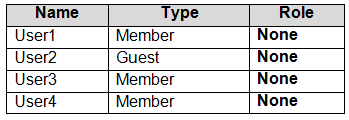
Sub1 contains two resource groups named RG1 and RG2 and the virtual networks shown in the following table.
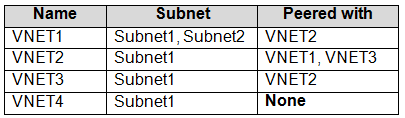
User1 manages the resources in RG1. User4 manages the resources in RG2.
Sub1 contains virtual machines that run Windows Server 2019 as shown in the following table
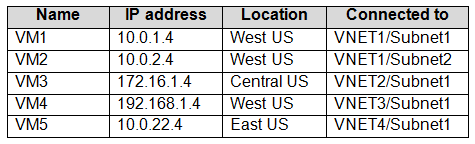
No network security groups (NSGs) are associated to the network interfaces or the subnets.
Sub1 contains the storage accounts shown in the following table.
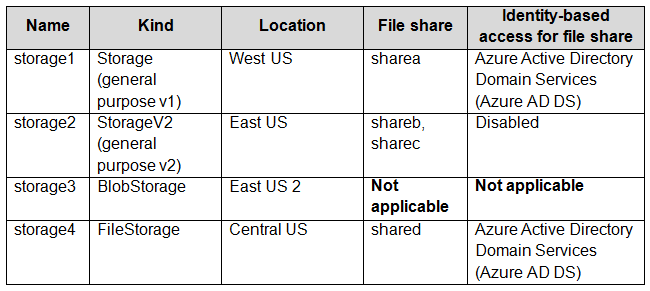
Requirements –
Planned Changes –
Contoso plans to implement the following changes:
Create a blob container named container1 and a file share named share1 that will use the Cool storage tier.
Create a storage account named storage5 and configure storage replication for the Blob service.
Create an NSG named NSG1 that will have the custom inbound security rules shown in the following table.

Associate NSG1 to the network interface of VM1.
Create an NSG named NSG2 that will have the custom outbound security rules shown in the following table.


Associate NSG2 to VNET1/Subnet2.
Technical Requirements –
Contoso must meet the following technical requirements:
Create container1 and share1.
Use the principle of least privilege.
Create an Azure AD security group named Group4.
Back up the Azure file shares and virtual machines by using Azure Backup.
Trigger an alert if VM1 or VM2 has less than 20 GB of free space on volume C.
Enable User1 to create Azure policy definitions and User2 to assign Azure policies to RG1.
Create an internal Basic Azure Load Balancer named LB1 and connect the load balancer to VNET1/Subnet1
Enable flow logging for IP traffic from VM5 and retain the flow logs for a period of eight months.
Whenever possible, grant Group4 Azure role-based access control (Azure RBAC) read-only permissions to the Azure file shares.QuestionHOTSPOT –
You need to configure Azure Backup to back up the file shares and virtual machines.
What is the minimum number of Recovery Services vaults and backup policies you should create? To answer, select the appropriate options in the answer area.
NOTE: Each correct selection is worth one point.
Hot Area:
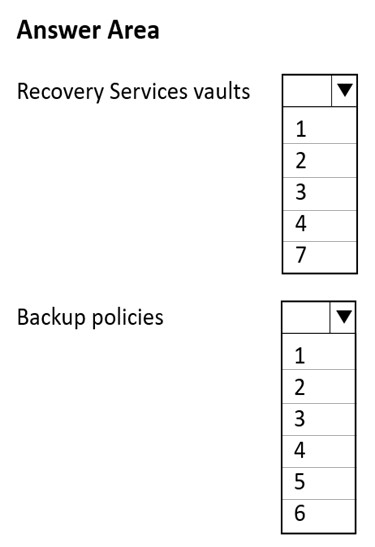
Correct Answer: 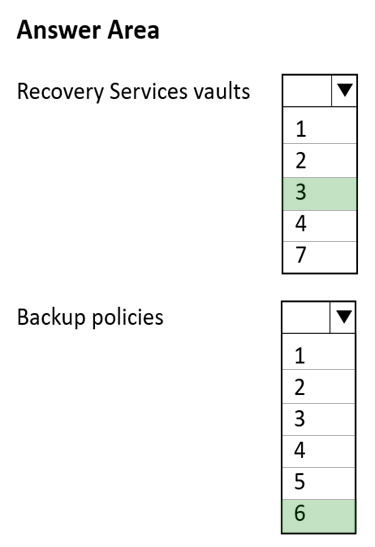
Box 1: 3 –
If you have data sources in multiple regions, create a Recovery Services vault for each region.
The File Shares and VMs are located in three Regions: West US, East US, Central US.
Box 2: 6 –
A backup policy is scoped to a vault. For each vault we need one backup policy for File Shares and one backup policy for VM.
Note:
Back up the Azure file shares and virtual machines by using Azure Backup
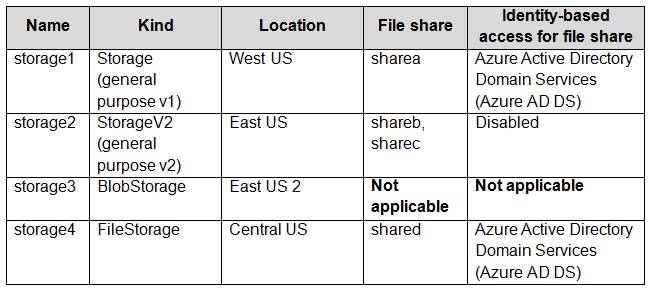
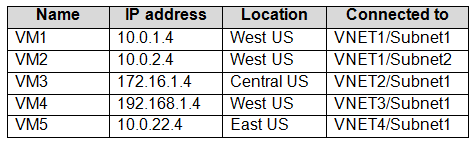
Reference:
https://docs.microsoft.com/en-us/azure/backup/backup-create-rs-vault https://docs.microsoft.com/en-us/azure/backup/guidance-best-practices
Question #2Topic 8
Introductory InfoCase study –
This is a case study. Case studies are not timed separately. You can use as much exam time as you would like to complete each case. However, there may be additional case studies and sections on this exam. You must manage your time to ensure that you are able to complete all questions included on this exam in the time provided.
To answer the questions included in a case study, you will need to reference information that is provided in the case study. Case studies might contain exhibits and other resources that provide more information about the scenario that is described in the case study. Each question is independent of the other questions in this case study.
At the end of this case study, a review screen will appear. This screen allows you to review your answers and to make changes before you move to the next section of the exam. After you begin a new section, you cannot return to this section.
To start the case study –
To display the first question in this case study, click the Next button. Use the buttons in the left pane to explore the content of the case study before you answer the questions. Clicking these buttons displays information such as business requirements, existing environment, and problem statements. If the case study has an All Information tab, note that the information displayed is identical to the information displayed on the subsequent tabs. When you are ready to answer a question, click the Question button to return to the question.
Overview –
General Overview –
Contoso, Ltd. is a consulting company that has a main office in Montreal and branch offices in Seattle and New York.
Environment –
Existing Environment –
Contoso has an Azure subscription named Sub1 that is linked to an Azure Active Directory (Azure AD) tenant. The network contains an on-premises Active
Directory domain that syncs to the Azure AD tenant.
The Azure AD tenant contains the users shown in the following table.
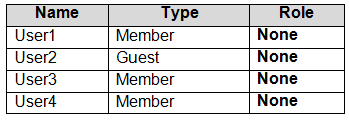
Sub1 contains two resource groups named RG1 and RG2 and the virtual networks shown in the following table.
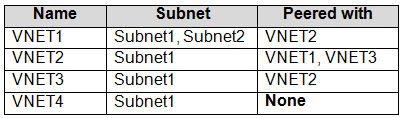
User1 manages the resources in RG1. User4 manages the resources in RG2.
Sub1 contains virtual machines that run Windows Server 2019 as shown in the following table
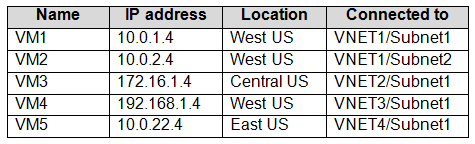
No network security groups (NSGs) are associated to the network interfaces or the subnets.
Sub1 contains the storage accounts shown in the following table.
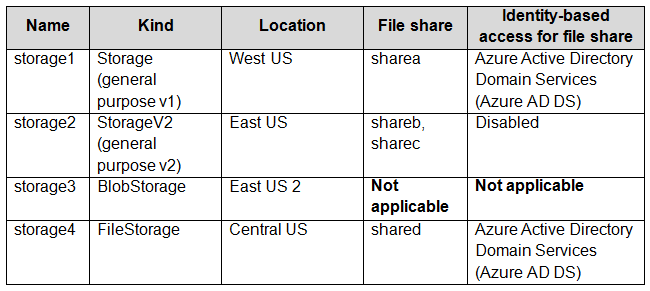
Requirements –
Planned Changes –
Contoso plans to implement the following changes:
Create a blob container named container1 and a file share named share1 that will use the Cool storage tier.
Create a storage account named storage5 and configure storage replication for the Blob service.
Create an NSG named NSG1 that will have the custom inbound security rules shown in the following table.

Associate NSG1 to the network interface of VM1.
Create an NSG named NSG2 that will have the custom outbound security rules shown in the following table.


Associate NSG2 to VNET1/Subnet2.
Technical Requirements –
Contoso must meet the following technical requirements:
Create container1 and share1.
Use the principle of least privilege.
Create an Azure AD security group named Group4.
Back up the Azure file shares and virtual machines by using Azure Backup.
Trigger an alert if VM1 or VM2 has less than 20 GB of free space on volume C.
Enable User1 to create Azure policy definitions and User2 to assign Azure policies to RG1.
Create an internal Basic Azure Load Balancer named LB1 and connect the load balancer to VNET1/Subnet1
Enable flow logging for IP traffic from VM5 and retain the flow logs for a period of eight months.
Whenever possible, grant Group4 Azure role-based access control (Azure RBAC) read-only permissions to the Azure file shares.QuestionDRAG DROP –
You need to configure the alerts for VM1 and VM2 to meet the technical requirements.
Which three actions should you perform in sequence? To answer, move all actions from the list of actions to the answer area and arrange them in the correct order.
Select and Place:

Correct Answer: 
Topic 9 – Testlet 2
Question #1Topic 9
Introductory InfoCase study –
This is a case study. Case studies are not timed separately. You can use as much exam time as you would like to complete each case. However, there may be additional case studies and sections on this exam. You must manage your time to ensure that you are able to complete all questions included on this exam in the time provided.
To answer the questions included in a case study, you will need to reference information that is provided in the case study. Case studies might contain exhibits and other resources that provide more information about the scenario that is described in the case study. Each question is independent of the other questions in this case study.
At the end of this case study, a review screen will appear. This screen allows you to review your answers and to make changes before you move to the next section of the exam. After you begin a new section, you cannot return to this section.
To start the case study –
To display the first question in this case study, click the Next button. Use the buttons in the left pane to explore the content of the case study before you answer the questions. Clicking these buttons displays information such as business requirements, existing environment, and problem statements. If the case study has an All Information tab, note that the information displayed is identical to the information displayed on the subsequent tabs. When you are ready to answer a question, click the Question button to return to the question.
Overview –
General Overview –
Contoso, Ltd. is a consulting company that has a main office in Montreal and branch offices in Seattle and New York.
Environment –
Existing Environment –
Contoso has an Azure subscription named Sub1 that is linked to an Azure Active Directory (Azure AD) tenant. The network contains an on-premises Active
Directory domain that syncs to the Azure AD tenant.
The Azure AD tenant contains the users shown in the following table.
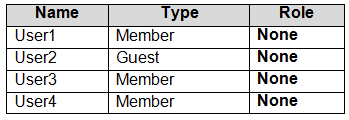
Sub1 contains two resource groups named RG1 and RG2 and the virtual networks shown in the following table.
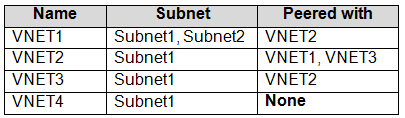
User1 manages the resources in RG1. User4 manages the resources in RG2.
Sub1 contains virtual machines that run Windows Server 2019 as shown in the following table
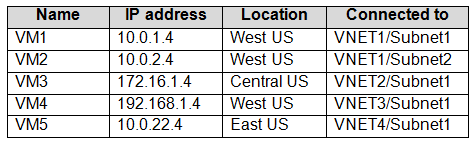
No network security groups (NSGs) are associated to the network interfaces or the subnets.
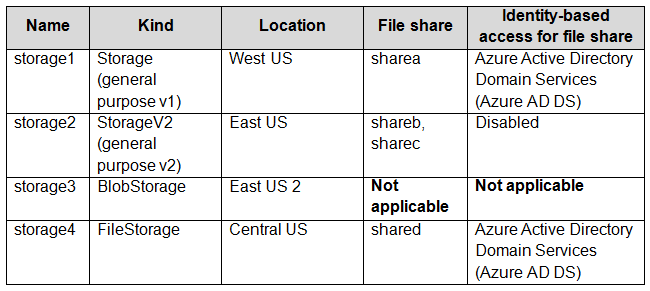
Sub1 contains the storage accounts shown in the following table.
Requirements –
Planned Changes –
Contoso plans to implement the following changes:
Create a blob container named container1 and a file share named share1 that will use the Cool storage tier.
Create a storage account named storage5 and configure storage replication for the Blob service.
Create an NSG named NSG1 that will have the custom inbound security rules shown in the following table.

Associate NSG1 to the network interface of VM1.
Create an NSG named NSG2 that will have the custom outbound security rules shown in the following table.


Associate NSG2 to VNET1/Subnet2.
Technical Requirements –
Contoso must meet the following technical requirements:
Create container1 and share1.
Use the principle of least privilege.
Create an Azure AD security group named Group4.
Back up the Azure file shares and virtual machines by using Azure Backup.
Trigger an alert if VM1 or VM2 has less than 20 GB of free space on volume C.
Enable User1 to create Azure policy definitions and User2 to assign Azure policies to RG1.
Create an internal Basic Azure Load Balancer named LB1 and connect the load balancer to VNET1/Subnet1
Enable flow logging for IP traffic from VM5 and retain the flow logs for a period of eight months.
Whenever possible, grant Group4 Azure role-based access control (Azure RBAC) read-only permissions to the Azure file shares.QuestionHOTSPOT –
You need to ensure that User1 can create initiative definitions, and User4 can assign initiatives to RG2. The solution must meet the technical requirements.
Which role should you assign to each user? To answer, select the appropriate options in the answer area.
NOTE: Each correct selection is worth one point.
Hot Area:
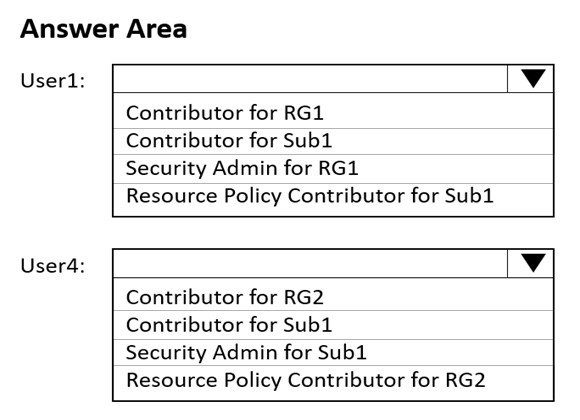
Correct Answer: 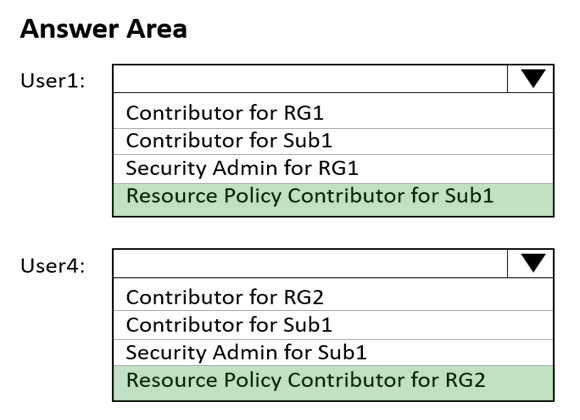
Reference:
https://docs.microsoft.com/en-us/azure/governance/policy/overview
Question #2Topic 9
Introductory InfoCase study –
This is a case study. Case studies are not timed separately. You can use as much exam time as you would like to complete each case. However, there may be additional case studies and sections on this exam. You must manage your time to ensure that you are able to complete all questions included on this exam in the time provided.
To answer the questions included in a case study, you will need to reference information that is provided in the case study. Case studies might contain exhibits and other resources that provide more information about the scenario that is described in the case study. Each question is independent of the other questions in this case study.
At the end of this case study, a review screen will appear. This screen allows you to review your answers and to make changes before you move to the next section of the exam. After you begin a new section, you cannot return to this section.
To start the case study –
To display the first question in this case study, click the Next button. Use the buttons in the left pane to explore the content of the case study before you answer the questions. Clicking these buttons displays information such as business requirements, existing environment, and problem statements. If the case study has an All Information tab, note that the information displayed is identical to the information displayed on the subsequent tabs. When you are ready to answer a question, click the Question button to return to the question.
Overview –
General Overview –
Contoso, Ltd. is a consulting company that has a main office in Montreal and branch offices in Seattle and New York.
Environment –
Existing Environment –
Contoso has an Azure subscription named Sub1 that is linked to an Azure Active Directory (Azure AD) tenant. The network contains an on-premises Active
Directory domain that syncs to the Azure AD tenant.
The Azure AD tenant contains the users shown in the following table.
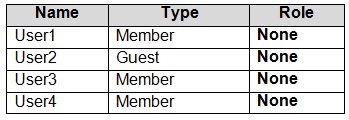
Sub1 contains two resource groups named RG1 and RG2 and the virtual networks shown in the following table.
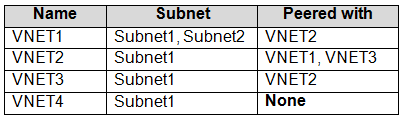
User1 manages the resources in RG1. User4 manages the resources in RG2.
Sub1 contains virtual machines that run Windows Server 2019 as shown in the following table
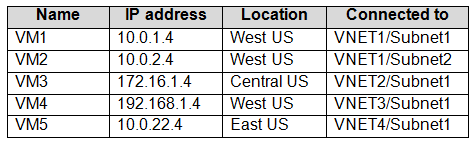
No network security groups (NSGs) are associated to the network interfaces or the subnets.
Sub1 contains the storage accounts shown in the following table.
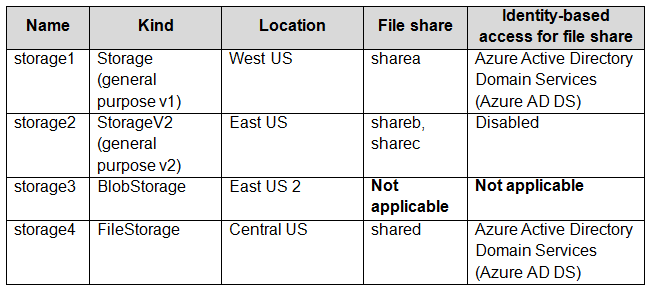
Requirements –
Planned Changes –
Contoso plans to implement the following changes:
Create a blob container named container1 and a file share named share1 that will use the Cool storage tier.
Create a storage account named storage5 and configure storage replication for the Blob service.
Create an NSG named NSG1 that will have the custom inbound security rules shown in the following table.

Associate NSG1 to the network interface of VM1.
Create an NSG named NSG2 that will have the custom outbound security rules shown in the following table.


Associate NSG2 to VNET1/Subnet2.
Technical Requirements –
Contoso must meet the following technical requirements:
Create container1 and share1.
Use the principle of least privilege.
Create an Azure AD security group named Group4.
Back up the Azure file shares and virtual machines by using Azure Backup.
Trigger an alert if VM1 or VM2 has less than 20 GB of free space on volume C.
Enable User1 to create Azure policy definitions and User2 to assign Azure policies to RG1.
Create an internal Basic Azure Load Balancer named LB1 and connect the load balancer to VNET1/Subnet1
Enable flow logging for IP traffic from VM5 and retain the flow logs for a period of eight months.
Whenever possible, grant Group4 Azure role-based access control (Azure RBAC) read-only permissions to the Azure file shares.QuestionYou need to ensure that you can grant Group4 Azure RBAC read only permissions to all the Azure file shares.
What should you do?
- A. On storage2, enable identity-based access for the file shares.
- B. Recreate storage2 and set Hierarchical namespace to Enabled.
- C. On storage1 and storage4, change the Account kind type to StorageV2 (general purpose v2).
- D. Create a shared access signature (SAS) for storage1, storage2, and storage4.
Correct Answer: A
Azure Files supports identity-based authentication over Server Message Block (SMB) through on-premises Active Directory Domain Services (AD DS) and Azure
Active Directory Domain Services (Azure AD DS).
Reference:
https://docs.microsoft.com/en-us/azure/storage/files/storage-files-active-directory-overview
Community vote distribution
A (100%)
Topic 10 – Testlet 3
Question #1Topic 10
Introductory InfoCase study –
This is a case study. Case studies are not timed separately. You can use as much exam time as you would like to complete each case. However, there may be additional case studies and sections on this exam. You must manage your time to ensure that you are able to complete all questions included on this exam in the time provided.
To answer the questions included in a case study, you will need to reference information that is provided in the case study. Case studies might contain exhibits and other resources that provide more information about the scenario that is described in the case study. Each question is independent of the other questions in this case study.
At the end of this case study, a review screen will appear. This screen allows you to review your answers and to make changes before you move to the next section of the exam. After you begin a new section, you cannot return to this section.
To start the case study –
To display the first question in this case study, click the Next button. Use the buttons in the left pane to explore the content of the case study before you answer the questions. Clicking these buttons displays information such as business requirements, existing environment, and problem statements. If the case study has an All Information tab, note that the information displayed is identical to the information displayed on the subsequent tabs. When you are ready to answer a question, click the Question button to return to the question.
Overview –
Contoso, Ltd. is a manufacturing company that has offices worldwide. Contoso works with partner organizations to bring products to market.
Contoso products are manufactured by using blueprint files that the company authors and maintains.
Existing Environment –
Currently, Contoso uses multiple types of servers for business operations, including the following:
File servers
Domain controllers
Microsoft SQL Server servers
Your network contains an Active Directory forest named contoso.com. All servers and client computers are joined to Active Directory.
You have a public-facing application named App1. App1 is comprised of the following three tiers:
A SQL database
A web front end
A processing middle tier –

Each tier is comprised of five virtual machines. Users access the web front end by using HTTPS only.
Requirements –
Planned Changes –
Contoso plans to implement the following changes to the infrastructure:
Move all the tiers of App1 to Azure.
Move the existing product blueprint files to Azure Blob storage.
Create a hybrid directory to support an upcoming Microsoft 365 migration project.
Technical Requirements –
Contoso must meet the following technical requirements:
Move all the virtual machines for App1 to Azure.
Minimize the number of open ports between the App1 tiers.
Ensure that all the virtual machines for App1 are protected by backups.
Copy the blueprint files to Azure over the Internet.
Ensure that the blueprint files are stored in the archive storage tier.
Ensure that partner access to the blueprint files is secured and temporary.
Prevent user passwords or hashes of passwords from being stored in Azure.
Use unmanaged standard storage for the hard disks of the virtual machines.
Ensure that when users join devices to Azure Active Directory (Azure AD), the users use a mobile phone to verify their identity.
Minimize administrative effort whenever possible.
User Requirements –
Contoso identifies the following requirements for users:
Ensure that only users who are part of a group named Pilot can join devices to Azure AD.
Designate a new user named Admin1 as the service admin for the Azure subscription.
Admin1 must receive email alerts regarding service outages.
Ensure that a new user named User3 can create network objects for the Azure subscription.QuestionYou need to implement a backup solution for App1 after the application is moved.
What should you create first?
- A. a recovery plan
- B. an Azure Backup Server
- C. a backup policy
- D. a Recovery Services vault
Correct Answer: D
A Recovery Services vault is a logical container that stores the backup data for each protected resource, such as Azure VMs. When the backup job for a protected resource runs, it creates a recovery point inside the Recovery Services vault.
Scenario:
There are three application tiers, each with five virtual machines.
Move all the virtual machines for App1 to Azure.
Ensure that all the virtual machines for App1 are protected by backups.
Reference:
https://docs.microsoft.com/en-us/azure/backup/quick-backup-vm-portal
Community vote distribution
D (100%)
Question #2Topic 10
Introductory InfoCase study –
This is a case study. Case studies are not timed separately. You can use as much exam time as you would like to complete each case. However, there may be additional case studies and sections on this exam. You must manage your time to ensure that you are able to complete all questions included on this exam in the time provided.
To answer the questions included in a case study, you will need to reference information that is provided in the case study. Case studies might contain exhibits and other resources that provide more information about the scenario that is described in the case study. Each question is independent of the other questions in this case study.
At the end of this case study, a review screen will appear. This screen allows you to review your answers and to make changes before you move to the next section of the exam. After you begin a new section, you cannot return to this section.
To start the case study –
To display the first question in this case study, click the Next button. Use the buttons in the left pane to explore the content of the case study before you answer the questions. Clicking these buttons displays information such as business requirements, existing environment, and problem statements. If the case study has an All Information tab, note that the information displayed is identical to the information displayed on the subsequent tabs. When you are ready to answer a question, click the Question button to return to the question.
Overview –
Contoso, Ltd. is a manufacturing company that has offices worldwide. Contoso works with partner organizations to bring products to market.
Contoso products are manufactured by using blueprint files that the company authors and maintains.
Existing Environment –
Currently, Contoso uses multiple types of servers for business operations, including the following:
File servers
Domain controllers
Microsoft SQL Server servers
Your network contains an Active Directory forest named contoso.com. All servers and client computers are joined to Active Directory.
You have a public-facing application named App1. App1 is comprised of the following three tiers:
A SQL database
A web front end
A processing middle tier –

Each tier is comprised of five virtual machines. Users access the web front end by using HTTPS only.
Requirements –
Planned Changes –
Contoso plans to implement the following changes to the infrastructure:
Move all the tiers of App1 to Azure.
Move the existing product blueprint files to Azure Blob storage.
Create a hybrid directory to support an upcoming Microsoft 365 migration project.
Technical Requirements –
Contoso must meet the following technical requirements:
Move all the virtual machines for App1 to Azure.
Minimize the number of open ports between the App1 tiers.
Ensure that all the virtual machines for App1 are protected by backups.
Copy the blueprint files to Azure over the Internet.
Ensure that the blueprint files are stored in the archive storage tier.
Ensure that partner access to the blueprint files is secured and temporary.
Prevent user passwords or hashes of passwords from being stored in Azure.
Use unmanaged standard storage for the hard disks of the virtual machines.
Ensure that when users join devices to Azure Active Directory (Azure AD), the users use a mobile phone to verify their identity.
Minimize administrative effort whenever possible.
User Requirements –
Contoso identifies the following requirements for users:
Ensure that only users who are part of a group named Pilot can join devices to Azure AD.
Designate a new user named Admin1 as the service admin for the Azure subscription.
Admin1 must receive email alerts regarding service outages.
Ensure that a new user named User3 can create network objects for the Azure subscription.QuestionYou need to move the blueprint files to Azure.
What should you do?
- A. Generate an access key. Map a drive, and then copy the files by using File Explorer.
- B. Use Azure Storage Explorer to copy the files.
- C. Use the Azure Import/Export service.
- D. Generate a shared access signature (SAS). Map a drive, and then copy the files by using File Explorer.
Correct Answer: B
Azure Storage Explorer is a free tool from Microsoft that allows you to work with Azure Storage data on Windows, macOS, and Linux. You can use it to upload and download data from Azure blob storage.
Scenario:
Planned Changes include: move the existing product blueprint files to Azure Blob storage.
Technical Requirements include: Copy the blueprint files to Azure over the Internet.
Reference:
https://docs.microsoft.com/en-us/azure/machine-learning/team-data-science-process/move-data-to-azure-blob-using-azure-storage-explorer
Community vote distribution
B (100%)
Question #3Topic 10
Introductory InfoCase study –
This is a case study. Case studies are not timed separately. You can use as much exam time as you would like to complete each case. However, there may be additional case studies and sections on this exam. You must manage your time to ensure that you are able to complete all questions included on this exam in the time provided.
To answer the questions included in a case study, you will need to reference information that is provided in the case study. Case studies might contain exhibits and other resources that provide more information about the scenario that is described in the case study. Each question is independent of the other questions in this case study.
At the end of this case study, a review screen will appear. This screen allows you to review your answers and to make changes before you move to the next section of the exam. After you begin a new section, you cannot return to this section.
To start the case study –
To display the first question in this case study, click the Next button. Use the buttons in the left pane to explore the content of the case study before you answer the questions. Clicking these buttons displays information such as business requirements, existing environment, and problem statements. If the case study has an All Information tab, note that the information displayed is identical to the information displayed on the subsequent tabs. When you are ready to answer a question, click the Question button to return to the question.
Overview –
Contoso, Ltd. is a manufacturing company that has offices worldwide. Contoso works with partner organizations to bring products to market.
Contoso products are manufactured by using blueprint files that the company authors and maintains.
Existing Environment –
Currently, Contoso uses multiple types of servers for business operations, including the following:
File servers
Domain controllers
Microsoft SQL Server servers
Your network contains an Active Directory forest named contoso.com. All servers and client computers are joined to Active Directory.
You have a public-facing application named App1. App1 is comprised of the following three tiers:
A SQL database
A web front end
A processing middle tier –

Each tier is comprised of five virtual machines. Users access the web front end by using HTTPS only.
Requirements –
Planned Changes –
Contoso plans to implement the following changes to the infrastructure:
Move all the tiers of App1 to Azure.
Move the existing product blueprint files to Azure Blob storage.
Create a hybrid directory to support an upcoming Microsoft 365 migration project.
Technical Requirements –
Contoso must meet the following technical requirements:
Move all the virtual machines for App1 to Azure.
Minimize the number of open ports between the App1 tiers.
Ensure that all the virtual machines for App1 are protected by backups.
Copy the blueprint files to Azure over the Internet.
Ensure that the blueprint files are stored in the archive storage tier.
Ensure that partner access to the blueprint files is secured and temporary.
Prevent user passwords or hashes of passwords from being stored in Azure.
Use unmanaged standard storage for the hard disks of the virtual machines.
Ensure that when users join devices to Azure Active Directory (Azure AD), the users use a mobile phone to verify their identity.
Minimize administrative effort whenever possible.
User Requirements –
Contoso identifies the following requirements for users:
Ensure that only users who are part of a group named Pilot can join devices to Azure AD.
Designate a new user named Admin1 as the service admin for the Azure subscription.
Admin1 must receive email alerts regarding service outages.
Ensure that a new user named User3 can create network objects for the Azure subscription.QuestionHOTSPOT –
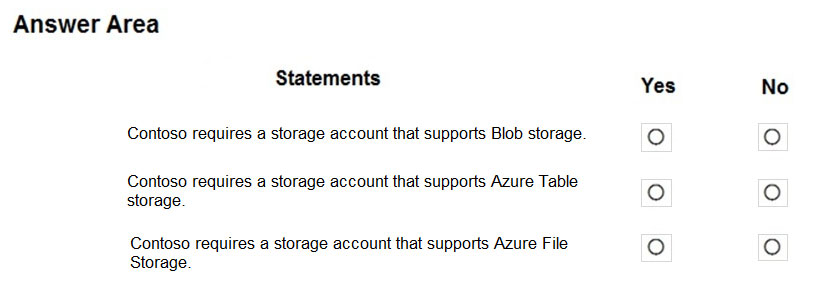
You need to identify the storage requirements for Contoso.
For each of the following statements, select Yes if the statement is true. Otherwise, select No.
NOTE: Each correct selection is worth one point.
Hot Area:
Correct Answer: 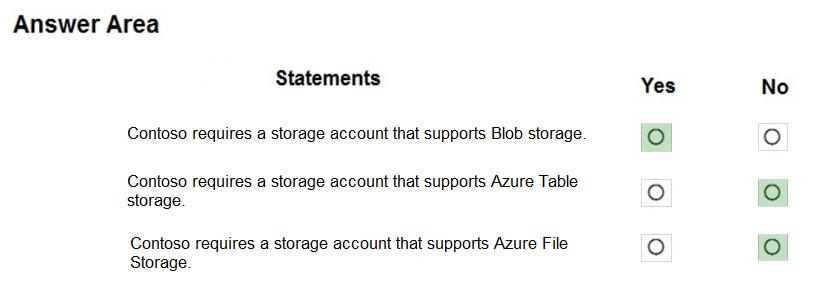
Box 1: Yes –
Contoso is moving the existing product blueprint files to Azure Blob storage.
Use unmanaged standard storage for the hard disks of the virtual machines. We use Page Blobs for these.
Box 2: No –
Box 3: No
Topic 11 – Testlet 4
Question #1Topic 11
Introductory InfoCase study –
This is a case study. Case studies are not timed separately. You can use as much exam time as you would like to complete each case. However, there may be additional case studies and sections on this exam. You must manage your time to ensure that you are able to complete all questions included on this exam in the time provided.
To answer the questions included in a case study, you will need to reference information that is provided in the case study. Case studies might contain exhibits and other resources that provide more information about the scenario that is described in the case study. Each question is independent of the other questions in this case study.
At the end of this case study, a review screen will appear. This screen allows you to review your answers and to make changes before you move to the next section of the exam. After you begin a new section, you cannot return to this section.
To start the case study –
To display the first question in this case study, click the Next button. Use the buttons in the left pane to explore the content of the case study before you answer the questions. Clicking these buttons displays information such as business requirements, existing environment, and problem statements. If the case study has an All Information tab, note that the information displayed is identical to the information displayed on the subsequent tabs. When you are ready to answer a question, click the Question button to return to the question.
Overview –
General Overview –
Contoso, Ltd. is a consulting company that has a main office in Montreal and branch offices in Seattle and New York.
Environment –
Existing Environment –
Contoso has an Azure subscription named Sub1 that is linked to an Azure Active Directory (Azure AD) tenant. The network contains an on-premises Active
Directory domain that syncs to the Azure AD tenant.
The Azure AD tenant contains the users shown in the following table.
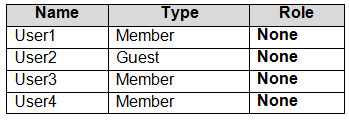
Sub1 contains two resource groups named RG1 and RG2 and the virtual networks shown in the following table.
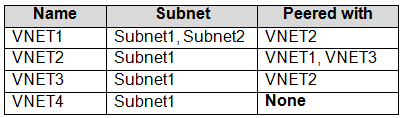
User1 manages the resources in RG1. User4 manages the resources in RG2.
Sub1 contains virtual machines that run Windows Server 2019 as shown in the following table
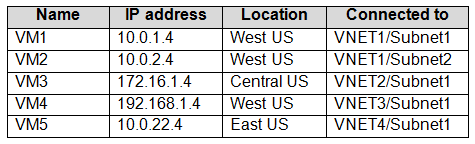
No network security groups (NSGs) are associated to the network interfaces or the subnets.
Sub1 contains the storage accounts shown in the following table.
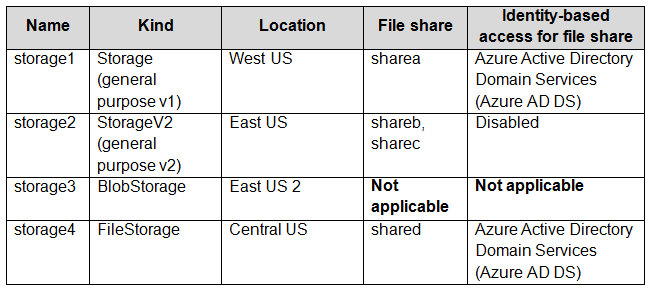
Requirements –
Planned Changes –
Contoso plans to implement the following changes:
Create a blob container named container1 and a file share named share1 that will use the Cool storage tier.
Create a storage account named storage5 and configure storage replication for the Blob service.
Create an NSG named NSG1 that will have the custom inbound security rules shown in the following table.

Associate NSG1 to the network interface of VM1.
Create an NSG named NSG2 that will have the custom outbound security rules shown in the following table.


Associate NSG2 to VNET1/Subnet2.
Technical Requirements –
Contoso must meet the following technical requirements:
Create container1 and share1.
Use the principle of least privilege.
Create an Azure AD security group named Group4.
Back up the Azure file shares and virtual machines by using Azure Backup.
Trigger an alert if VM1 or VM2 has less than 20 GB of free space on volume C.
Enable User1 to create Azure policy definitions and User2 to assign Azure policies to RG1.
Create an internal Basic Azure Load Balancer named LB1 and connect the load balancer to VNET1/Subnet1
Enable flow logging for IP traffic from VM5 and retain the flow logs for a period of eight months.
Whenever possible, grant Group4 Azure role-based access control (Azure RBAC) read-only permissions to the Azure file shares.QuestionHOTSPOT –
You need to create container1 and share1.
Which storage accounts should you use for each resource? To answer, select the appropriate options in the answer area.
NOTE: Each correct selection is worth one point.
Hot Area:
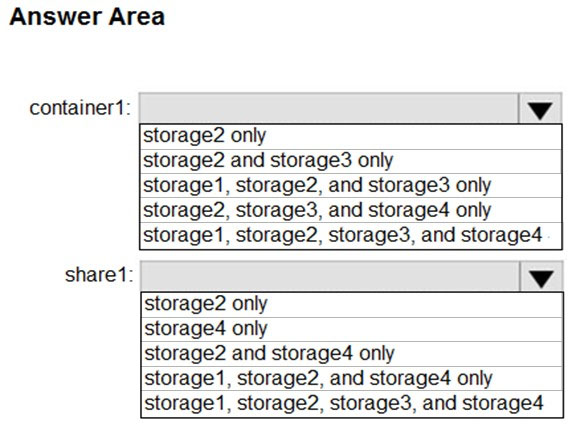
Correct Answer: 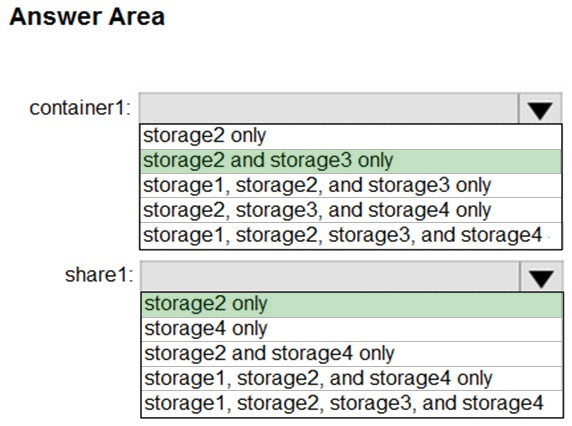
Reference:
https://docs.microsoft.com/en-us/azure/storage/blobs/storage-blob-storage-tiers https://docs.microsoft.com/en-us/azure/storage/common/storage-account-overview
Question #2Topic 11
Introductory InfoCase study –
This is a case study. Case studies are not timed separately. You can use as much exam time as you would like to complete each case. However, there may be additional case studies and sections on this exam. You must manage your time to ensure that you are able to complete all questions included on this exam in the time provided.
To answer the questions included in a case study, you will need to reference information that is provided in the case study. Case studies might contain exhibits and other resources that provide more information about the scenario that is described in the case study. Each question is independent of the other questions in this case study.
At the end of this case study, a review screen will appear. This screen allows you to review your answers and to make changes before you move to the next section of the exam. After you begin a new section, you cannot return to this section.
To start the case study –
To display the first question in this case study, click the Next button. Use the buttons in the left pane to explore the content of the case study before you answer the questions. Clicking these buttons displays information such as business requirements, existing environment, and problem statements. If the case study has an All Information tab, note that the information displayed is identical to the information displayed on the subsequent tabs. When you are ready to answer a question, click the Question button to return to the question.
Overview –
General Overview –
Contoso, Ltd. is a consulting company that has a main office in Montreal and branch offices in Seattle and New York.
Environment –
Existing Environment –
Contoso has an Azure subscription named Sub1 that is linked to an Azure Active Directory (Azure AD) tenant. The network contains an on-premises Active
Directory domain that syncs to the Azure AD tenant.
The Azure AD tenant contains the users shown in the following table.
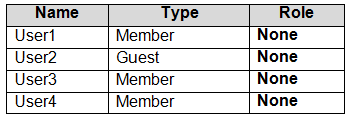
Sub1 contains two resource groups named RG1 and RG2 and the virtual networks shown in the following table.
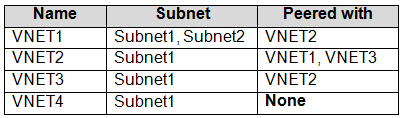
User1 manages the resources in RG1. User4 manages the resources in RG2.
Sub1 contains virtual machines that run Windows Server 2019 as shown in the following table
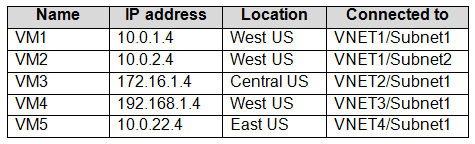
No network security groups (NSGs) are associated to the network interfaces or the subnets.
Sub1 contains the storage accounts shown in the following table.
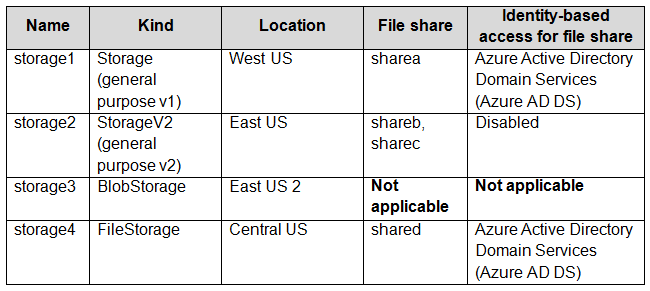
Requirements –
Planned Changes –
Contoso plans to implement the following changes:
Create a blob container named container1 and a file share named share1 that will use the Cool storage tier.
Create a storage account named storage5 and configure storage replication for the Blob service.
Create an NSG named NSG1 that will have the custom inbound security rules shown in the following table.

Associate NSG1 to the network interface of VM1.
Create an NSG named NSG2 that will have the custom outbound security rules shown in the following table.


Associate NSG2 to VNET1/Subnet2.
Technical Requirements –
Contoso must meet the following technical requirements:
Create container1 and share1.
Use the principle of least privilege.
Create an Azure AD security group named Group4.
Back up the Azure file shares and virtual machines by using Azure Backup.
Trigger an alert if VM1 or VM2 has less than 20 GB of free space on volume C.
Enable User1 to create Azure policy definitions and User2 to assign Azure policies to RG1.
Create an internal Basic Azure Load Balancer named LB1 and connect the load balancer to VNET1/Subnet1
Enable flow logging for IP traffic from VM5 and retain the flow logs for a period of eight months.
Whenever possible, grant Group4 Azure role-based access control (Azure RBAC) read-only permissions to the Azure file shares.QuestionHOTSPOT –
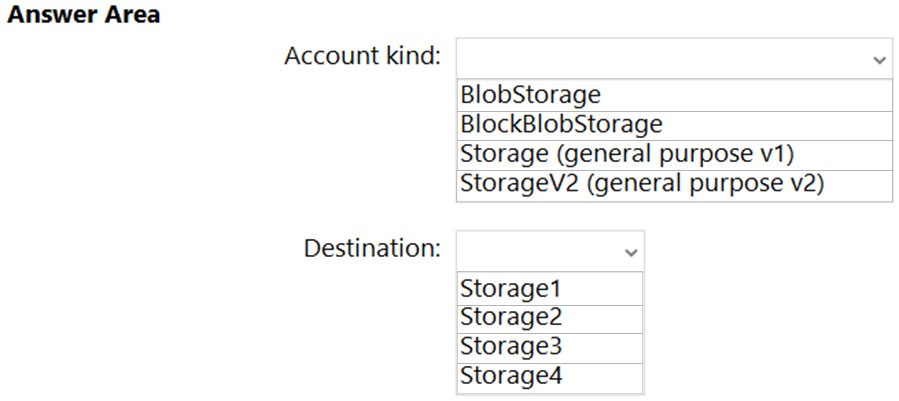
You need to create storage5. The solution must support the planned changes.
Which type of storage account should you use, and which account should you configure as the destination storage account? To answer, select the appropriate options in the answer area.
NOTE: Each correct selection is worth one point.
Hot Area:
Correct Answer: 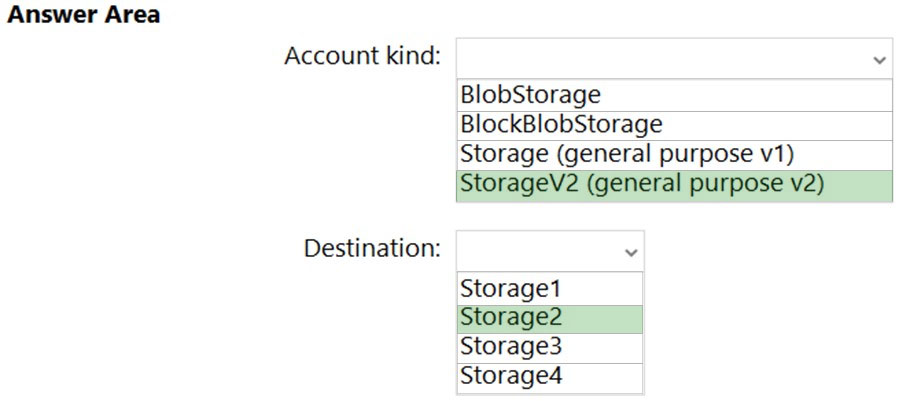
Reference:
https://docs.microsoft.com/en-us/azure/storage/blobs/object-replication-configure?tabs=portal
Question #3Topic 11
Introductory InfoCase study –
This is a case study. Case studies are not timed separately. You can use as much exam time as you would like to complete each case. However, there may be additional case studies and sections on this exam. You must manage your time to ensure that you are able to complete all questions included on this exam in the time provided.
To answer the questions included in a case study, you will need to reference information that is provided in the case study. Case studies might contain exhibits and other resources that provide more information about the scenario that is described in the case study. Each question is independent of the other questions in this case study.
At the end of this case study, a review screen will appear. This screen allows you to review your answers and to make changes before you move to the next section of the exam. After you begin a new section, you cannot return to this section.
To start the case study –
To display the first question in this case study, click the Next button. Use the buttons in the left pane to explore the content of the case study before you answer the questions. Clicking these buttons displays information such as business requirements, existing environment, and problem statements. If the case study has an All Information tab, note that the information displayed is identical to the information displayed on the subsequent tabs. When you are ready to answer a question, click the Question button to return to the question.
Overview –
General Overview –
Contoso, Ltd. is a consulting company that has a main office in Montreal and branch offices in Seattle and New York.
Environment –
Existing Environment –
Contoso has an Azure subscription named Sub1 that is linked to an Azure Active Directory (Azure AD) tenant. The network contains an on-premises Active
Directory domain that syncs to the Azure AD tenant.
The Azure AD tenant contains the users shown in the following table.
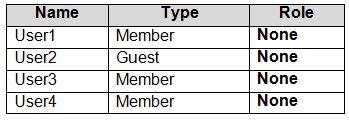
Sub1 contains two resource groups named RG1 and RG2 and the virtual networks shown in the following table.
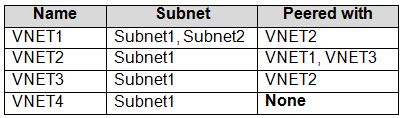
User1 manages the resources in RG1. User4 manages the resources in RG2.
Sub1 contains virtual machines that run Windows Server 2019 as shown in the following table
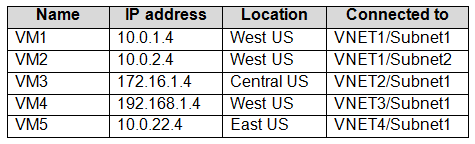
No network security groups (NSGs) are associated to the network interfaces or the subnets.
Sub1 contains the storage accounts shown in the following table.
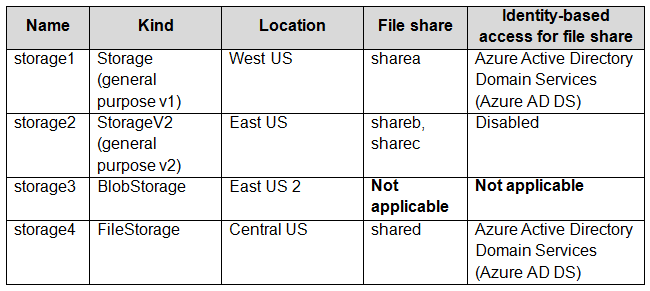
Requirements –
Planned Changes –
Contoso plans to implement the following changes:
Create a blob container named container1 and a file share named share1 that will use the Cool storage tier.
Create a storage account named storage5 and configure storage replication for the Blob service.
Create an NSG named NSG1 that will have the custom inbound security rules shown in the following table.

Associate NSG1 to the network interface of VM1.
Create an NSG named NSG2 that will have the custom outbound security rules shown in the following table.


Associate NSG2 to VNET1/Subnet2.
Technical Requirements –
Contoso must meet the following technical requirements:
Create container1 and share1.
Use the principle of least privilege.
Create an Azure AD security group named Group4.
Back up the Azure file shares and virtual machines by using Azure Backup.
Trigger an alert if VM1 or VM2 has less than 20 GB of free space on volume C.
Enable User1 to create Azure policy definitions and User2 to assign Azure policies to RG1.
Create an internal Basic Azure Load Balancer named LB1 and connect the load balancer to VNET1/Subnet1
Enable flow logging for IP traffic from VM5 and retain the flow logs for a period of eight months.
Whenever possible, grant Group4 Azure role-based access control (Azure RBAC) read-only permissions to the Azure file shares.QuestionYou need to identify which storage account to use for the flow logging of IP traffic from VM5. The solution must meet the retention requirements.
Which storage account should you identify?
- A. storage1
- B. storage2
- C. storage3
- D. storage4
Correct Answer: C
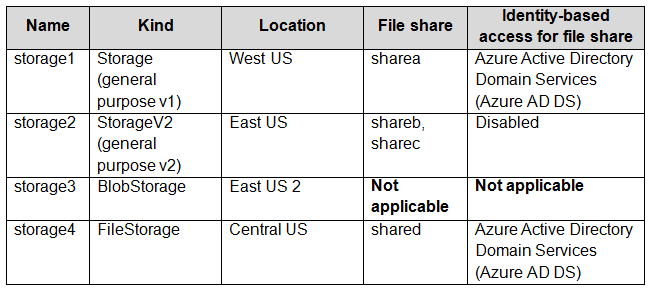
We use the BlobStorage account storage3 for retention.
Storage lifecycle management offers a rule-based policy that you can use to transition blob data to the appropriate access tiers or to expire data at the end of the data lifecycle.
Note: Enable flow logging for IP traffic from VM5 and retain the flow logs for a period of eight months.
Reference:
https://docs.microsoft.com/en-us/azure/storage/blobs/lifecycle-management-overview https://docs.microsoft.com/en-us/azure/network-watcher/network-watcher-nsg-flow-logging-overview
Community vote distribution
B (100%)
Topic 12 – Testlet 5
Question #1Topic 12
Introductory InfoCase study –
This is a case study. Case studies are not timed separately. You can use as much exam time as you would like to complete each case. However, there may be additional case studies and sections on this exam. You must manage your time to ensure that you are able to complete all questions included on this exam in the time provided.
To answer the questions included in a case study, you will need to reference information that is provided in the case study. Case studies might contain exhibits and other resources that provide more information about the scenario that is described in the case study. Each question is independent of the other questions in this case study.
At the end of this case study, a review screen will appear. This screen allows you to review your answers and to make changes before you move to the next section of the exam. After you begin a new section, you cannot return to this section.
To start the case study –
To display the first question in this case study, click the Next button. Use the buttons in the left pane to explore the content of the case study before you answer the questions. Clicking these buttons displays information such as business requirements, existing environment, and problem statements. If the case study has an All Information tab, note that the information displayed is identical to the information displayed on the subsequent tabs. When you are ready to answer a question, click the Question button to return to the question.
Overview –
Litware, Inc. is a consulting company that has a main office in Montreal and two branch offices in Seattle and New York.
The Montreal office has 2,000 employees. The Seattle office has 1,000 employees. The New York office has 200 employees.
All the resources used by Litware are hosted on-premises.
Litware creates a new Azure subscription. The Azure Active Directory (Azure AD) tenant uses a domain named litware.onmicrosoft.com. The tenant uses the
Premium P1 pricing tier.
Existing Environment –
The network contains an Active Directory forest named litware.com. All domain controllers are configured as DNS servers and host the litware.com DNS zone.
Litware has finance, human resources, sales, research, and information technology departments. Each department has an organizational unit (OU) that contains all the accounts of that respective department. All the user accounts have the department attribute set to their respective department. New users are added frequently.
Litware.com contains a user named User1.
All the offices connect by using private connections.
Litware has data centers in the Montreal and Seattle offices. Each office has a firewall that can be configured as a VPN device.
All infrastructure servers are virtualized. The virtualization environment contains the servers in the following table.

Litware uses two web applications named App1 and App2. Each instance on each web application requires 1 GB of memory.
The Azure subscription contains the resources in the following table.
The network security team implements several network security groups (NSGs)
Requirements –
Planned Changes –
Litware plans to implement the following changes:
Deploy Azure ExpressRoute to the Montreal office.
Migrate the virtual machines hosted on Server1 and Server2 to Azure.
Synchronize on-premises Active Directory to Azure Active Directory (Azure AD).
Migrate App1 and App2 to two Azure web apps named WebApp1 and WebApp2.
Technical Requirements –
Litware must meet the following technical requirements:
Ensure that WebApp1 can adjust the number of instances automatically based on the load and can scale up to five instances.

Ensure that VM3 can establish outbound connections over TCP port 8080 to the applications servers in the Montreal office.
Ensure that routing information is exchanged automatically between Azure and the routers in the Montreal office.
Enable Azure Multi-Factor Authentication (MFA) for the users in the finance department only.
Ensure that webapp2.azurewebsites.net can be accessed by using the name app2.litware.com.
Connect the New York office to VNet1 over the Internet by using an encrypted connection.
Create a workflow to send an email message when the settings of VM4 are modified.
Create a custom Azure role named Role1 that is based on the Reader role.
Minimize costs whenever possible.QuestionYou discover that VM3 does NOT meet the technical requirements.
You need to verify whether the issue relates to the NSGs.
What should you use?
- A. Diagram in VNet1
- B. Diagnostic settings in Azure Monitor
- C. Diagnose and solve problems in Traffic Manager profiles
- D. The security recommendations in Azure Advisor
- E. IP flow verify in Azure Network Watcher
Correct Answer: E
Scenario: Contoso must meet technical requirements including:
Ensure that VM3 can establish outbound connections over TCP port 8080 to the applications servers in the Montreal office.
IP flow verify checks if a packet is allowed or denied to or from a virtual machine. The information consists of direction, protocol, local IP, remote IP, local port, and remote port. If the packet is denied by a security group, the name of the rule that denied the packet is returned. While any source or destination IP can be chosen,
IP flow verify helps administrators quickly diagnose connectivity issues from or to the internet and from or to the on-premises environment.
Reference:
https://docs.microsoft.com/en-us/azure/network-watcher/network-watcher-ip-flow-verify-overview
Community vote distribution
E (100%)
Topic 13 – Testlet 6
Question #1Topic 13
Introductory InfoCase study –
This is a case study. Case studies are not timed separately. You can use as much exam time as you would like to complete each case. However, there may be additional case studies and sections on this exam. You must manage your time to ensure that you are able to complete all questions included on this exam in the time provided.
To answer the questions included in a case study, you will need to reference information that is provided in the case study. Case studies might contain exhibits and other resources that provide more information about the scenario that is described in the case study. Each question is independent of the other questions in this case study.
At the end of this case study, a review screen will appear. This screen allows you to review your answers and to make changes before you move to the next section of the exam. After you begin a new section, you cannot return to this section.
To start the case study –
To display the first question in this case study, click the Next button. Use the buttons in the left pane to explore the content of the case study before you answer the questions. Clicking these buttons displays information such as business requirements, existing environment, and problem statements. If the case study has an All Information tab, note that the information displayed is identical to the information displayed on the subsequent tabs. When you are ready to answer a question, click the Question button to return to the question.
Overview –
Litware, Inc. is a consulting company that has a main office in Montreal and two branch offices in Seattle and New York.
The Montreal office has 2,000 employees. The Seattle office has 1,000 employees. The New York office has 200 employees.
All the resources used by Litware are hosted on-premises.
Litware creates a new Azure subscription. The Azure Active Directory (Azure AD) tenant uses a domain named litware.onmicrosoft.com. The tenant uses the
Premium P1 pricing tier.
Existing Environment –
The network contains an Active Directory forest named litware.com. All domain controllers are configured as DNS servers and host the litware.com DNS zone.
Litware has finance, human resources, sales, research, and information technology departments. Each department has an organizational unit (OU) that contains all the accounts of that respective department. All the user accounts have the department attribute set to their respective department. New users are added frequently.
Litware.com contains a user named User1.
All the offices connect by using private connections.
Litware has data centers in the Montreal and Seattle offices. Each office has a firewall that can be configured as a VPN device.
All infrastructure servers are virtualized. The virtualization environment contains the servers in the following table.

Litware uses two web applications named App1 and App2. Each instance on each web application requires 1 GB of memory.
The Azure subscription contains the resources in the following table.
The network security team implements several network security groups (NSGs)
Requirements –
Planned Changes –
Litware plans to implement the following changes:
Deploy Azure ExpressRoute to the Montreal office.
Migrate the virtual machines hosted on Server1 and Server2 to Azure.
Synchronize on-premises Active Directory to Azure Active Directory (Azure AD).
Migrate App1 and App2 to two Azure web apps named WebApp1 and WebApp2.
Technical Requirements –
Litware must meet the following technical requirements:
Ensure that WebApp1 can adjust the number of instances automatically based on the load and can scale up to five instances.

Ensure that VM3 can establish outbound connections over TCP port 8080 to the applications servers in the Montreal office.
Ensure that routing information is exchanged automatically between Azure and the routers in the Montreal office.
Enable Azure Multi-Factor Authentication (MFA) for the users in the finance department only.
Ensure that webapp2.azurewebsites.net can be accessed by using the name app2.litware.com.
Connect the New York office to VNet1 over the Internet by using an encrypted connection.
Create a workflow to send an email message when the settings of VM4 are modified.
Create a custom Azure role named Role1 that is based on the Reader role.
Minimize costs whenever possible.QuestionYou need to ensure that VM1 can communicate with VM4. The solution must minimize the administrative effort.
What should you do?
- A. Create an NSG and associate the NSG to VM1 and VM4.
- B. Establish peering between VNET1 and VNET3.
- C. Assign VM4 an IP address of 10.0.1.5/24.
- D. Create a user-defined route from VNET1 to VNET3.
Correct Answer: C
Reference:
https://docs.microsoft.com/en-us/azure/vpn-gateway/tutorial-site-to-site-portal
Community vote distribution
B (88%)
13%
Question #2Topic 13
Introductory InfoCase study –
This is a case study. Case studies are not timed separately. You can use as much exam time as you would like to complete each case. However, there may be additional case studies and sections on this exam. You must manage your time to ensure that you are able to complete all questions included on this exam in the time provided.
To answer the questions included in a case study, you will need to reference information that is provided in the case study. Case studies might contain exhibits and other resources that provide more information about the scenario that is described in the case study. Each question is independent of the other questions in this case study.
At the end of this case study, a review screen will appear. This screen allows you to review your answers and to make changes before you move to the next section of the exam. After you begin a new section, you cannot return to this section.
To start the case study –
To display the first question in this case study, click the Next button. Use the buttons in the left pane to explore the content of the case study before you answer the questions. Clicking these buttons displays information such as business requirements, existing environment, and problem statements. If the case study has an All Information tab, note that the information displayed is identical to the information displayed on the subsequent tabs. When you are ready to answer a question, click the Question button to return to the question.
Overview –
Litware, Inc. is a consulting company that has a main office in Montreal and two branch offices in Seattle and New York.
The Montreal office has 2,000 employees. The Seattle office has 1,000 employees. The New York office has 200 employees.
All the resources used by Litware are hosted on-premises.
Litware creates a new Azure subscription. The Azure Active Directory (Azure AD) tenant uses a domain named litware.onmicrosoft.com. The tenant uses the
Premium P1 pricing tier.
Existing Environment –
The network contains an Active Directory forest named litware.com. All domain controllers are configured as DNS servers and host the litware.com DNS zone.
Litware has finance, human resources, sales, research, and information technology departments. Each department has an organizational unit (OU) that contains all the accounts of that respective department. All the user accounts have the department attribute set to their respective department. New users are added frequently.
Litware.com contains a user named User1.
All the offices connect by using private connections.
Litware has data centers in the Montreal and Seattle offices. Each office has a firewall that can be configured as a VPN device.
All infrastructure servers are virtualized. The virtualization environment contains the servers in the following table.

Litware uses two web applications named App1 and App2. Each instance on each web application requires 1 GB of memory.
The Azure subscription contains the resources in the following table.
The network security team implements several network security groups (NSGs)
Requirements –
Planned Changes –
Litware plans to implement the following changes:
Deploy Azure ExpressRoute to the Montreal office.
Migrate the virtual machines hosted on Server1 and Server2 to Azure.
Synchronize on-premises Active Directory to Azure Active Directory (Azure AD).
Migrate App1 and App2 to two Azure web apps named WebApp1 and WebApp2.
Technical Requirements –
Litware must meet the following technical requirements:
Ensure that WebApp1 can adjust the number of instances automatically based on the load and can scale up to five instances.

Ensure that VM3 can establish outbound connections over TCP port 8080 to the applications servers in the Montreal office.
Ensure that routing information is exchanged automatically between Azure and the routers in the Montreal office.
Enable Azure Multi-Factor Authentication (MFA) for the users in the finance department only.
Ensure that webapp2.azurewebsites.net can be accessed by using the name app2.litware.com.
Connect the New York office to VNet1 over the Internet by using an encrypted connection.
Create a workflow to send an email message when the settings of VM4 are modified.
Create a custom Azure role named Role1 that is based on the Reader role.
Minimize costs whenever possible.QuestionHOTSPOT –
You need to meet the connection requirements for the New York office.
What should you do? To answer, select the appropriate options in the answer area.
NOTE: Each correct selection is worth one point.
Hot Area:
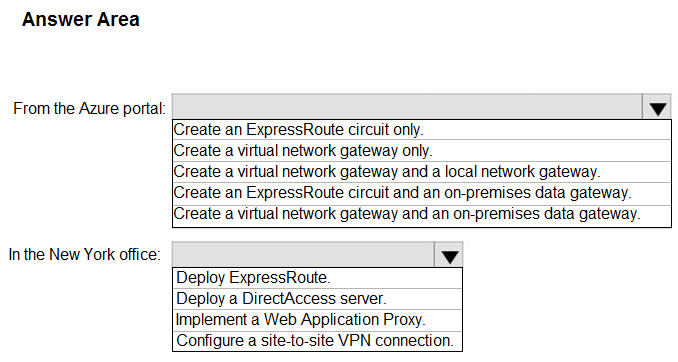
Correct Answer: 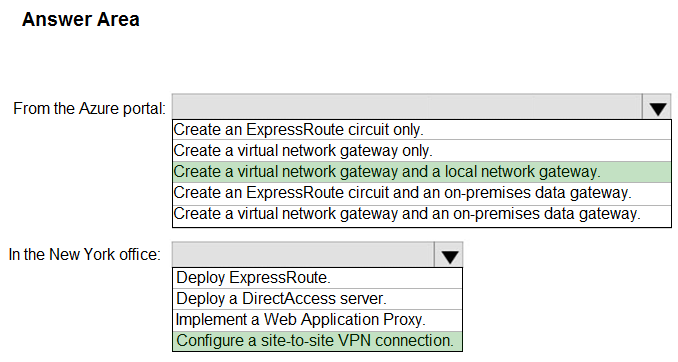
Box 1: Create a virtual network gateway and a local network gateway.
Azure VPN gateway. The VPN gateway service enables you to connect the VNet to the on-premises network through a VPN appliance. For more information, see
Connect an on-premises network to a Microsoft Azure virtual network. The VPN gateway includes the following elements:
✑ Virtual network gateway. A resource that provides a virtual VPN appliance for the VNet. It is responsible for routing traffic from the on-premises network to the
VNet.
✑ Local network gateway. An abstraction of the on-premises VPN appliance. Network traffic from the cloud application to the on-premises network is routed through this gateway.
✑ Connection. The connection has properties that specify the connection type (IPSec) and the key shared with the on-premises VPN appliance to encrypt traffic.
✑ Gateway subnet. The virtual network gateway is held in its own subnet, which is subject to various requirements, described in the Recommendations section below.
Box 2: Configure a site-to-site VPN connection
On premises create a site-to-site connection for the virtual network gateway and the local network gateway.
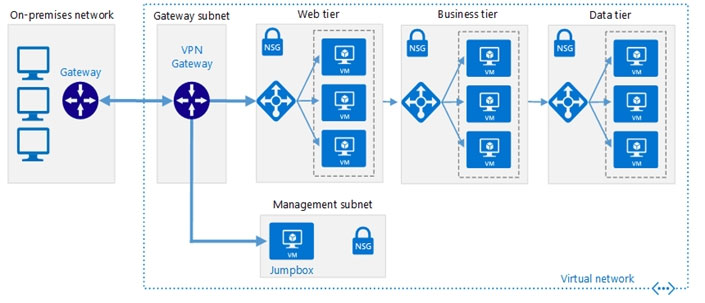
Scenario: Connect the New York office to VNet1 over the Internet by using an encrypted connection.
Incorrect Answers:
Azure ExpressRoute: Established between your network and Azure, through an ExpressRoute partner. This connection is private. Traffic does not go over the internet.
Reference:
https://docs.microsoft.com/en-us/azure/architecture/reference-architectures/hybrid-networking/vpn
Topic 14 – Testlet 7
Question #1Topic 14
Introductory InfoCase study –
This is a case study. Case studies are not timed separately. You can use as much exam time as you would like to complete each case. However, there may be additional case studies and sections on this exam. You must manage your time to ensure that you are able to complete all questions included on this exam in the time provided.
To answer the questions included in a case study, you will need to reference information that is provided in the case study. Case studies might contain exhibits and other resources that provide more information about the scenario that is described in the case study. Each question is independent of the other questions in this case study.
At the end of this case study, a review screen will appear. This screen allows you to review your answers and to make changes before you move to the next section of the exam. After you begin a new section, you cannot return to this section.
To start the case study –
To display the first question in this case study, click the Next button. Use the buttons in the left pane to explore the content of the case study before you answer the questions. Clicking these buttons displays information such as business requirements, existing environment, and problem statements. If the case study has an All Information tab, note that the information displayed is identical to the information displayed on the subsequent tabs. When you are ready to answer a question, click the Question button to return to the question.
Overview –
Contoso, Ltd. is a manufacturing company that has offices worldwide. Contoso works with partner organizations to bring products to market.
Contoso products are manufactured by using blueprint files that the company authors and maintains.
Existing Environment –
Currently, Contoso uses multiple types of servers for business operations, including the following:
File servers
Domain controllers
Microsoft SQL Server servers
Your network contains an Active Directory forest named contoso.com. All servers and client computers are joined to Active Directory.
You have a public-facing application named App1. App1 is comprised of the following three tiers:
A SQL database
A web front end
A processing middle tier –

Each tier is comprised of five virtual machines. Users access the web front end by using HTTPS only.
Requirements –
Planned Changes –
Contoso plans to implement the following changes to the infrastructure:
Move all the tiers of App1 to Azure.
Move the existing product blueprint files to Azure Blob storage.
Create a hybrid directory to support an upcoming Microsoft 365 migration project.
Technical Requirements –
Contoso must meet the following technical requirements:
Move all the virtual machines for App1 to Azure.
Minimize the number of open ports between the App1 tiers.
Ensure that all the virtual machines for App1 are protected by backups.
Copy the blueprint files to Azure over the Internet.
Ensure that the blueprint files are stored in the archive storage tier.
Ensure that partner access to the blueprint files is secured and temporary.
Prevent user passwords or hashes of passwords from being stored in Azure.
Use unmanaged standard storage for the hard disks of the virtual machines.
Ensure that when users join devices to Azure Active Directory (Azure AD), the users use a mobile phone to verify their identity.
Minimize administrative effort whenever possible.
User Requirements –
Contoso identifies the following requirements for users:
Ensure that only users who are part of a group named Pilot can join devices to Azure AD.
Designate a new user named Admin1 as the service admin for the Azure subscription.
Admin1 must receive email alerts regarding service outages.
Ensure that a new user named User3 can create network objects for the Azure subscription.QuestionHOTSPOT –
You need to recommend a solution for App1. The solution must meet the technical requirements.
What should you include in the recommendation? To answer, select the appropriate options in the answer area.
NOTE: Each correct selection is worth one point.
Hot Area:
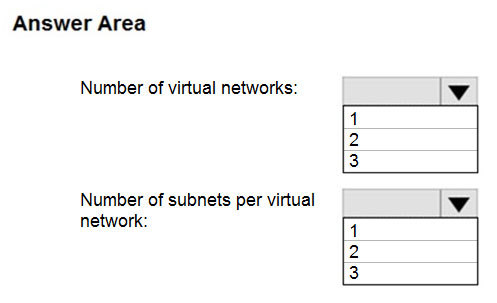
Correct Answer: 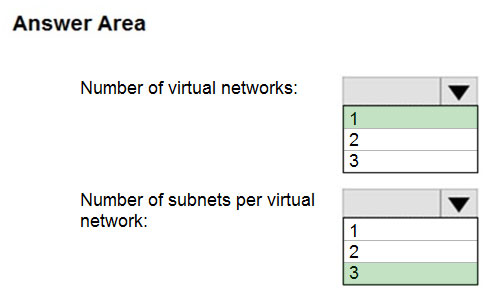
This reference architecture shows how to deploy VMs and a virtual network configured for an N-tier application, using SQL Server on Windows for the data tier.
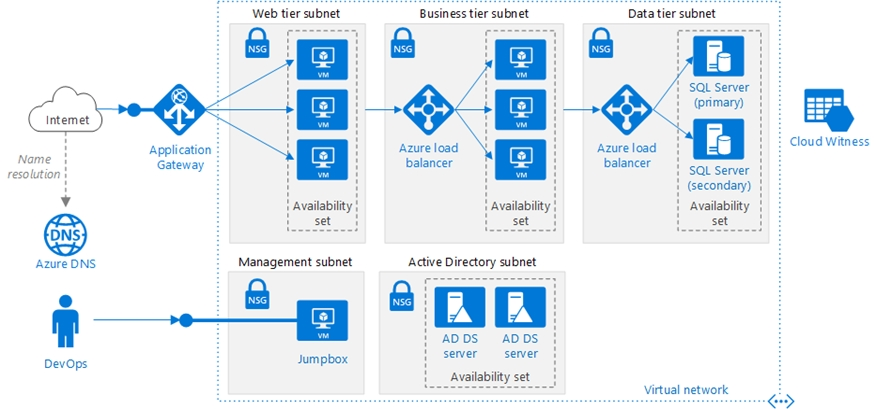
Scenario: You have a public-facing application named App1. App1 is comprised of the following three tiers:
✑ A SQL database
✑ A web front end
✑ A processing middle tier
Each tier is comprised of five virtual machines. Users access the web front end by using HTTPS only.
Technical requirements include:
✑ Move all the virtual machines for App1 to Azure.
✑ Minimize the number of open ports between the App1 tiers.
Reference:
https://docs.microsoft.com/en-us/azure/architecture/reference-architectures/n-tier/n-tier-sql-server
Question #2Topic 14
Introductory InfoCase study –
This is a case study. Case studies are not timed separately. You can use as much exam time as you would like to complete each case. However, there may be additional case studies and sections on this exam. You must manage your time to ensure that you are able to complete all questions included on this exam in the time provided.
To answer the questions included in a case study, you will need to reference information that is provided in the case study. Case studies might contain exhibits and other resources that provide more information about the scenario that is described in the case study. Each question is independent of the other questions in this case study.
At the end of this case study, a review screen will appear. This screen allows you to review your answers and to make changes before you move to the next section of the exam. After you begin a new section, you cannot return to this section.
To start the case study –
To display the first question in this case study, click the Next button. Use the buttons in the left pane to explore the content of the case study before you answer the questions. Clicking these buttons displays information such as business requirements, existing environment, and problem statements. If the case study has an All Information tab, note that the information displayed is identical to the information displayed on the subsequent tabs. When you are ready to answer a question, click the Question button to return to the question.
Overview –
Contoso, Ltd. is a manufacturing company that has offices worldwide. Contoso works with partner organizations to bring products to market.
Contoso products are manufactured by using blueprint files that the company authors and maintains.
Existing Environment –
Currently, Contoso uses multiple types of servers for business operations, including the following:
File servers
Domain controllers
Microsoft SQL Server servers
Your network contains an Active Directory forest named contoso.com. All servers and client computers are joined to Active Directory.
You have a public-facing application named App1. App1 is comprised of the following three tiers:
A SQL database
A web front end
A processing middle tier –

Each tier is comprised of five virtual machines. Users access the web front end by using HTTPS only.
Requirements –
Planned Changes –
Contoso plans to implement the following changes to the infrastructure:
Move all the tiers of App1 to Azure.
Move the existing product blueprint files to Azure Blob storage.
Create a hybrid directory to support an upcoming Microsoft 365 migration project.
Technical Requirements –
Contoso must meet the following technical requirements:
Move all the virtual machines for App1 to Azure.
Minimize the number of open ports between the App1 tiers.
Ensure that all the virtual machines for App1 are protected by backups.
Copy the blueprint files to Azure over the Internet.
Ensure that the blueprint files are stored in the archive storage tier.
Ensure that partner access to the blueprint files is secured and temporary.
Prevent user passwords or hashes of passwords from being stored in Azure.
Use unmanaged standard storage for the hard disks of the virtual machines.
Ensure that when users join devices to Azure Active Directory (Azure AD), the users use a mobile phone to verify their identity.
Minimize administrative effort whenever possible.
User Requirements –
Contoso identifies the following requirements for users:
Ensure that only users who are part of a group named Pilot can join devices to Azure AD.
Designate a new user named Admin1 as the service admin for the Azure subscription.
Admin1 must receive email alerts regarding service outages.
Ensure that a new user named User3 can create network objects for the Azure subscription.QuestionYou are planning the move of App1 to Azure.
You create a network security group (NSG).
You need to recommend a solution to provide users with access to App1.
What should you recommend?
- A. Create an incoming security rule for port 443 from the Internet. Associate the NSG to the subnet that contains the web servers.
- B. Create an outgoing security rule for port 443 from the Internet. Associate the NSG to the subnet that contains the web servers.
- C. Create an incoming security rule for port 443 from the Internet. Associate the NSG to all the subnets.
- D. Create an outgoing security rule for port 443 from the Internet. Associate the NSG to all the subnets.
Correct Answer: A
Incoming and the web server subnet only, as users access the web front end by using HTTPS only.
Note Scenario: You have a public-facing application named App1. App1 is comprised of the following three tiers:
✑ A SQL database
✑ A web front end
✑ A processing middle tier
Each tier is comprised of five virtual machines. Users access the web front end by using HTTPS only.
Community vote distribution
A (100%)
Topic 15 – Testlet 8
Question #1Topic 15
Introductory InfoCase study –
This is a case study. Case studies are not timed separately. You can use as much exam time as you would like to complete each case. However, there may be additional case studies and sections on this exam. You must manage your time to ensure that you are able to complete all questions included on this exam in the time provided.
To answer the questions included in a case study, you will need to reference information that is provided in the case study. Case studies might contain exhibits and other resources that provide more information about the scenario that is described in the case study. Each question is independent of the other questions in this case study.
At the end of this case study, a review screen will appear. This screen allows you to review your answers and to make changes before you move to the next section of the exam. After you begin a new section, you cannot return to this section.
To start the case study –
To display the first question in this case study, click the Next button. Use the buttons in the left pane to explore the content of the case study before you answer the questions. Clicking these buttons displays information such as business requirements, existing environment, and problem statements. If the case study has an All Information tab, note that the information displayed is identical to the information displayed on the subsequent tabs. When you are ready to answer a question, click the Question button to return to the question.
Overview –
General Overview –
Contoso, Ltd. is a consulting company that has a main office in Montreal and branch offices in Seattle and New York.
Environment –
Existing Environment –
Contoso has an Azure subscription named Sub1 that is linked to an Azure Active Directory (Azure AD) tenant. The network contains an on-premises Active
Directory domain that syncs to the Azure AD tenant.
The Azure AD tenant contains the users shown in the following table.
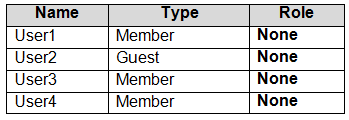
Sub1 contains two resource groups named RG1 and RG2 and the virtual networks shown in the following table.
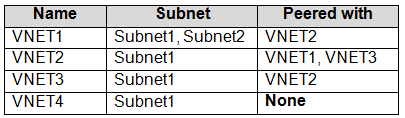
User1 manages the resources in RG1. User4 manages the resources in RG2.
Sub1 contains virtual machines that run Windows Server 2019 as shown in the following table
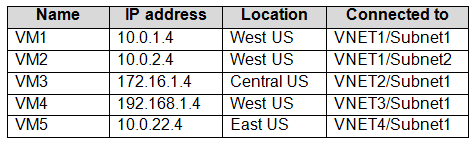
No network security groups (NSGs) are associated to the network interfaces or the subnets.
Sub1 contains the storage accounts shown in the following table.
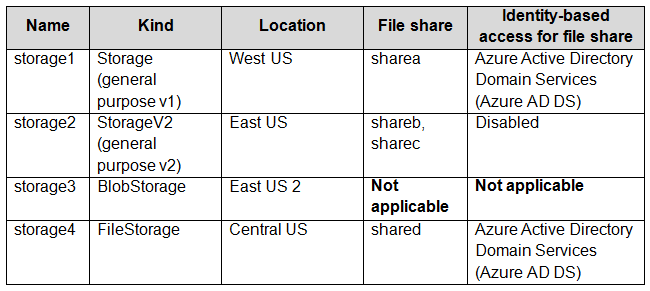
Requirements –
Planned Changes –
Contoso plans to implement the following changes:
Create a blob container named container1 and a file share named share1 that will use the Cool storage tier.
Create a storage account named storage5 and configure storage replication for the Blob service.
Create an NSG named NSG1 that will have the custom inbound security rules shown in the following table.

Associate NSG1 to the network interface of VM1.
Create an NSG named NSG2 that will have the custom outbound security rules shown in the following table.


Associate NSG2 to VNET1/Subnet2.
Technical Requirements –
Contoso must meet the following technical requirements:
Create container1 and share1.
Use the principle of least privilege.
Create an Azure AD security group named Group4.
Back up the Azure file shares and virtual machines by using Azure Backup.
Trigger an alert if VM1 or VM2 has less than 20 GB of free space on volume C.
Enable User1 to create Azure policy definitions and User2 to assign Azure policies to RG1.
Create an internal Basic Azure Load Balancer named LB1 and connect the load balancer to VNET1/Subnet1
Enable flow logging for IP traffic from VM5 and retain the flow logs for a period of eight months.
Whenever possible, grant Group4 Azure role-based access control (Azure RBAC) read-only permissions to the Azure file shares.QuestionHOTSPOT –
You implement the planned changes for NSG1 and NSG2.
For each of the following statements, select Yes if the statement is true. Otherwise, select No.
NOTE: Each correct selection is worth one point.
Hot Area:
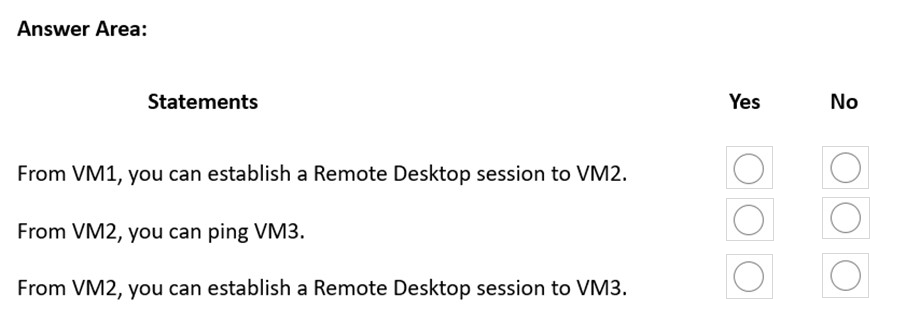
Correct Answer: 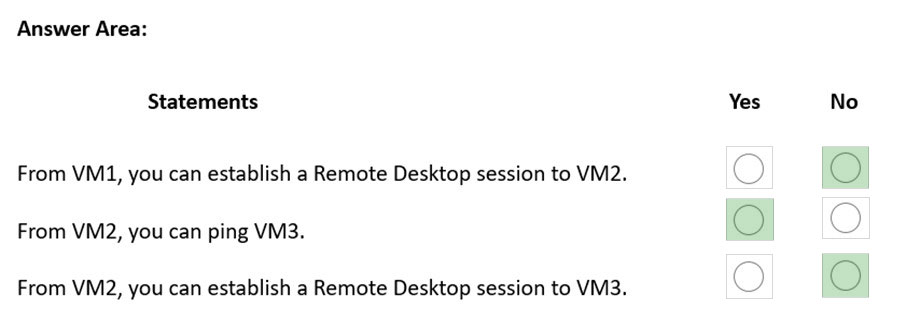
Box 1: No –
NSG2 blocks RDP to VM2 –
Box 2: Yes –
ICMP is not blocked –
Box 3: No –
NSG2 blocks RDP from VM2 –
Reference:
https://docs.microsoft.com/en-us/azure/virtual-network/network-security-group-how-it-works
Question #3Topic 15
Introductory InfoCase study –
This is a case study. Case studies are not timed separately. You can use as much exam time as you would like to complete each case. However, there may be additional case studies and sections on this exam. You must manage your time to ensure that you are able to complete all questions included on this exam in the time provided.
To answer the questions included in a case study, you will need to reference information that is provided in the case study. Case studies might contain exhibits and other resources that provide more information about the scenario that is described in the case study. Each question is independent of the other questions in this case study.
At the end of this case study, a review screen will appear. This screen allows you to review your answers and to make changes before you move to the next section of the exam. After you begin a new section, you cannot return to this section.
To start the case study –
To display the first question in this case study, click the Next button. Use the buttons in the left pane to explore the content of the case study before you answer the questions. Clicking these buttons displays information such as business requirements, existing environment, and problem statements. If the case study has an All Information tab, note that the information displayed is identical to the information displayed on the subsequent tabs. When you are ready to answer a question, click the Question button to return to the question.
Overview –
General Overview –
Contoso, Ltd. is a consulting company that has a main office in Montreal and branch offices in Seattle and New York.
Environment –
Existing Environment –
Contoso has an Azure subscription named Sub1 that is linked to an Azure Active Directory (Azure AD) tenant. The network contains an on-premises Active
Directory domain that syncs to the Azure AD tenant.
The Azure AD tenant contains the users shown in the following table.
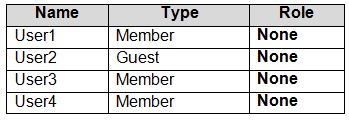
Sub1 contains two resource groups named RG1 and RG2 and the virtual networks shown in the following table.
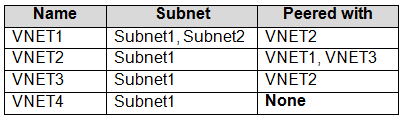
User1 manages the resources in RG1. User4 manages the resources in RG2.
Sub1 contains virtual machines that run Windows Server 2019 as shown in the following table
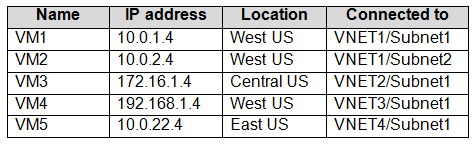
No network security groups (NSGs) are associated to the network interfaces or the subnets.
Sub1 contains the storage accounts shown in the following table.
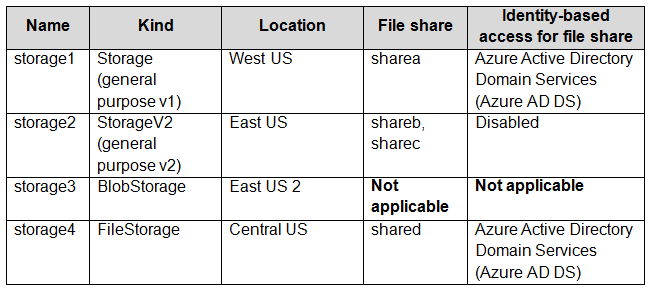
Requirements –
Planned Changes –
Contoso plans to implement the following changes:
Create a blob container named container1 and a file share named share1 that will use the Cool storage tier.
Create a storage account named storage5 and configure storage replication for the Blob service.
Create an NSG named NSG1 that will have the custom inbound security rules shown in the following table.

Associate NSG1 to the network interface of VM1.
Create an NSG named NSG2 that will have the custom outbound security rules shown in the following table.


Associate NSG2 to VNET1/Subnet2.
Technical Requirements –
Contoso must meet the following technical requirements:
Create container1 and share1.
Use the principle of least privilege.
Create an Azure AD security group named Group4.
Back up the Azure file shares and virtual machines by using Azure Backup.
Trigger an alert if VM1 or VM2 has less than 20 GB of free space on volume C.
Enable User1 to create Azure policy definitions and User2 to assign Azure policies to RG1.
Create an internal Basic Azure Load Balancer named LB1 and connect the load balancer to VNET1/Subnet1
Enable flow logging for IP traffic from VM5 and retain the flow logs for a period of eight months.
Whenever possible, grant Group4 Azure role-based access control (Azure RBAC) read-only permissions to the Azure file shares.QuestionYou need to add VM1 and VM2 to the backend pool of LB1.
What should you do first?
- A. Connect VM2 to VNET1/Subnet1.
- B. Redeploy VM1 and VM2 to the same availability zone.
- C. Redeploy VM1 and VM2 to the same availability set.
- D. Create a new NSG and associate the NSG to VNET1/Subnet1.
Correct Answer: A
VM1 is already in VNET1/Subnet1.
VM2 is on VNET1/Subnet2, and must be moved to VNET1/Subnet1.
Note:
Create an internal Basic Azure Load Balancer named LB1 and connect the load balancer to VNET1/Subnet1
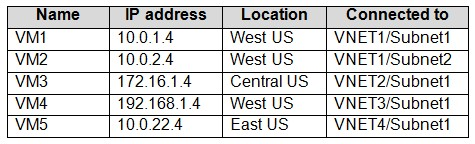
Reference:
https://docs.microsoft.com/en-us/azure/load-balancer/quickstart-load-balancer-standard-internal-portal
Community vote distribution
C (71%)
A (26%)
3%
Question #4Topic 15
You need to ensure that VM1 can communicate with VM4. The solution must minimize administrative effort.
What should you do?
- A. Create a user-defined route from VNET1 to VNET3.
- B. Create an NSG and associate the NSG to VM1 and VM4.
- C. Assign VM4 an IP address of 10.0.1.5/24.
- D. Establish peering between VNET1 and VNET3.
Correct Answer: D
Community vote distribution
D (100%)
Topic 16 – Testlet 9
Question #1Topic 16
Introductory InfoCase study –
This is a case study. Case studies are not timed separately. You can use as much exam time as you would like to complete each case. However, there may be additional case studies and sections on this exam. You must manage your time to ensure that you are able to complete all questions included on this exam in the time provided.
To answer the questions included in a case study, you will need to reference information that is provided in the case study. Case studies might contain exhibits and other resources that provide more information about the scenario that is described in the case study. Each question is independent of the other questions in this case study.
At the end of this case study, a review screen will appear. This screen allows you to review your answers and to make changes before you move to the next section of the exam. After you begin a new section, you cannot return to this section.
To start the case study –
To display the first question in this case study, click the Next button. Use the buttons in the left pane to explore the content of the case study before you answer the questions. Clicking these buttons displays information such as business requirements, existing environment, and problem statements. If the case study has an All Information tab, note that the information displayed is identical to the information displayed on the subsequent tabs. When you are ready to answer a question, click the Question button to return to the question.
Overview –
Litware, Inc. is a consulting company that has a main office in Montreal and two branch offices in Seattle and New York.
The Montreal office has 2,000 employees. The Seattle office has 1,000 employees. The New York office has 200 employees.
All the resources used by Litware are hosted on-premises.
Litware creates a new Azure subscription. The Azure Active Directory (Azure AD) tenant uses a domain named litware.onmicrosoft.com. The tenant uses the
Premium P1 pricing tier.
Existing Environment –
The network contains an Active Directory forest named litware.com. All domain controllers are configured as DNS servers and host the litware.com DNS zone.
Litware has finance, human resources, sales, research, and information technology departments. Each department has an organizational unit (OU) that contains all the accounts of that respective department. All the user accounts have the department attribute set to their respective department. New users are added frequently.
Litware.com contains a user named User1.
All the offices connect by using private connections.
Litware has data centers in the Montreal and Seattle offices. Each office has a firewall that can be configured as a VPN device.
All infrastructure servers are virtualized. The virtualization environment contains the servers in the following table.

Litware uses two web applications named App1 and App2. Each instance on each web application requires 1 GB of memory.
The Azure subscription contains the resources in the following table.
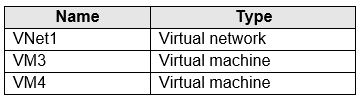
The network security team implements several network security groups (NSGs)
Requirements –
Planned Changes –
Litware plans to implement the following changes:
Deploy Azure ExpressRoute to the Montreal office.
Migrate the virtual machines hosted on Server1 and Server2 to Azure.
Synchronize on-premises Active Directory to Azure Active Directory (Azure AD).
Migrate App1 and App2 to two Azure web apps named WebApp1 and WebApp2.
Technical Requirements –
Litware must meet the following technical requirements:
Ensure that WebApp1 can adjust the number of instances automatically based on the load and can scale up to five instances.

Ensure that VM3 can establish outbound connections over TCP port 8080 to the applications servers in the Montreal office.
Ensure that routing information is exchanged automatically between Azure and the routers in the Montreal office.
Enable Azure Multi-Factor Authentication (MFA) for the users in the finance department only.
Ensure that webapp2.azurewebsites.net can be accessed by using the name app2.litware.com.
Connect the New York office to VNet1 over the Internet by using an encrypted connection.
Create a workflow to send an email message when the settings of VM4 are modified.
Create a custom Azure role named Role1 that is based on the Reader role.
Minimize costs whenever possible.QuestionHOTSPOT –
You need to implement Role1.
Which command should you run before you create Role1? To answer, select the appropriate options in the answer area.
NOTE: Each correct selection is worth one point.
Hot Area:
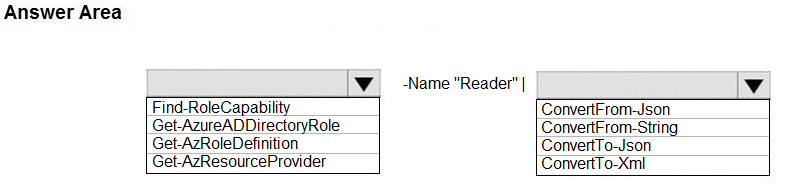
Correct Answer: 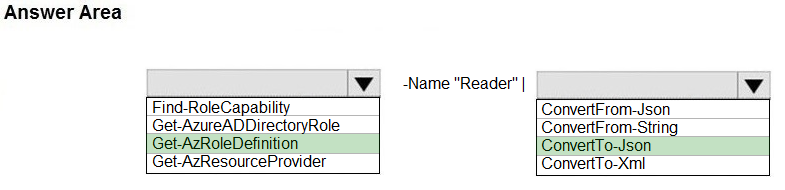
Question #2Topic 16
Introductory InfoCase study –
This is a case study. Case studies are not timed separately. You can use as much exam time as you would like to complete each case. However, there may be additional case studies and sections on this exam. You must manage your time to ensure that you are able to complete all questions included on this exam in the time provided.
To answer the questions included in a case study, you will need to reference information that is provided in the case study. Case studies might contain exhibits and other resources that provide more information about the scenario that is described in the case study. Each question is independent of the other questions in this case study.
At the end of this case study, a review screen will appear. This screen allows you to review your answers and to make changes before you move to the next section of the exam. After you begin a new section, you cannot return to this section.
To start the case study –
To display the first question in this case study, click the Next button. Use the buttons in the left pane to explore the content of the case study before you answer the questions. Clicking these buttons displays information such as business requirements, existing environment, and problem statements. If the case study has an All Information tab, note that the information displayed is identical to the information displayed on the subsequent tabs. When you are ready to answer a question, click the Question button to return to the question.
Overview –
Litware, Inc. is a consulting company that has a main office in Montreal and two branch offices in Seattle and New York.
The Montreal office has 2,000 employees. The Seattle office has 1,000 employees. The New York office has 200 employees.
All the resources used by Litware are hosted on-premises.
Litware creates a new Azure subscription. The Azure Active Directory (Azure AD) tenant uses a domain named litware.onmicrosoft.com. The tenant uses the
Premium P1 pricing tier.
Existing Environment –
The network contains an Active Directory forest named litware.com. All domain controllers are configured as DNS servers and host the litware.com DNS zone.
Litware has finance, human resources, sales, research, and information technology departments. Each department has an organizational unit (OU) that contains all the accounts of that respective department. All the user accounts have the department attribute set to their respective department. New users are added frequently.
Litware.com contains a user named User1.
All the offices connect by using private connections.
Litware has data centers in the Montreal and Seattle offices. Each office has a firewall that can be configured as a VPN device.
All infrastructure servers are virtualized. The virtualization environment contains the servers in the following table.

Litware uses two web applications named App1 and App2. Each instance on each web application requires 1 GB of memory.
The Azure subscription contains the resources in the following table.
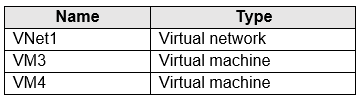
The network security team implements several network security groups (NSGs)
Requirements –
Planned Changes –
Litware plans to implement the following changes:
Deploy Azure ExpressRoute to the Montreal office.
Migrate the virtual machines hosted on Server1 and Server2 to Azure.
Synchronize on-premises Active Directory to Azure Active Directory (Azure AD).
Migrate App1 and App2 to two Azure web apps named WebApp1 and WebApp2.
Technical Requirements –
Litware must meet the following technical requirements:
Ensure that WebApp1 can adjust the number of instances automatically based on the load and can scale up to five instances.

Ensure that VM3 can establish outbound connections over TCP port 8080 to the applications servers in the Montreal office.
Ensure that routing information is exchanged automatically between Azure and the routers in the Montreal office.
Enable Azure Multi-Factor Authentication (MFA) for the users in the finance department only.
Ensure that webapp2.azurewebsites.net can be accessed by using the name app2.litware.com.
Connect the New York office to VNet1 over the Internet by using an encrypted connection.
Create a workflow to send an email message when the settings of VM4 are modified.
Create a custom Azure role named Role1 that is based on the Reader role.
Minimize costs whenever possible.QuestionYou need to recommend a solution to automate the configuration for the finance department users. The solution must meet the technical requirements.
What should you include in the recommendation?
- A. Azure AD B2C
- B. dynamic groups and conditional access policies
- C. Azure AD Identity Protection
- D. an Azure logic app and the Microsoft Identity Management (MIM) client
Correct Answer: B
Scenario: Ensure Azure Multi-Factor Authentication (MFA) for the users in the finance department only.
The recommendation is to use conditional access policies that can then be targeted to groups of users, specific applications, or other conditions.
Reference:
https://docs.microsoft.com/en-us/azure/active-directory/authentication/howto-mfa-userstates
Community vote distribution
B (100%)
