
Free Dumps, Free Microsoft Dump
Free AZ-305 Dump
Question #111Topic 4
HOTSPOT
–
You have an Azure App Service web app named Webapp1 that connects to an Azure SQL database named DB1. Webapp1 and DB1 are deployed to the East US Azure region.
You need to ensure that all the traffic between Webapp1 and DB1 is sent via a private connection.
What should you do? To answer, select the appropriate options in the answer area.
NOTE: Each correct selection is worth one point.
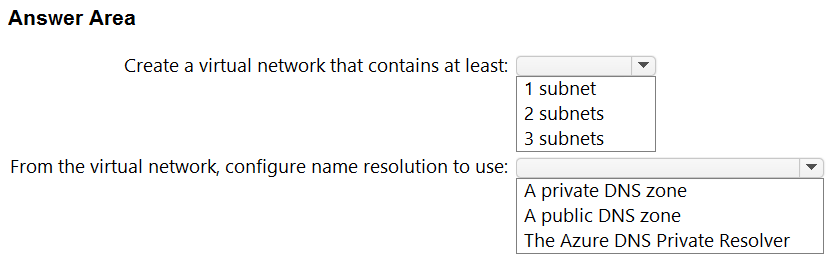
Correct Answer: 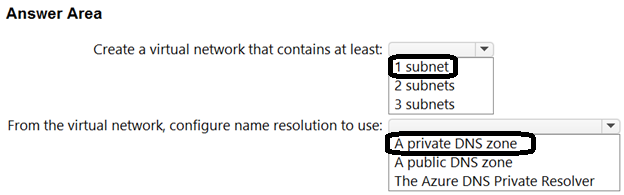
Question #112Topic 4
HOTSPOT
–
Your on-premises network contains an Active Directory Domain Services (AD DS) domain. The domain contains a server named Server1. Server1 contains an app named App1 that uses AD DS authentication. Remote users access App1 by using a VPN connection to the on-premises network.
You have an Azure AD tenant that syncs with the AD DS domain by using Azure AD Connect.
You need to ensure that the remote users can access App1 without using a VPN. The solution must meet the following requirements:
• Ensure that the users authenticate by using Azure Multi-Factor Authentication (MFA).
• Minimize administrative effort.
What should you include in the solution? To answer, select the appropriate options in the answer area.
NOTE: Each correct selection is worth one point.
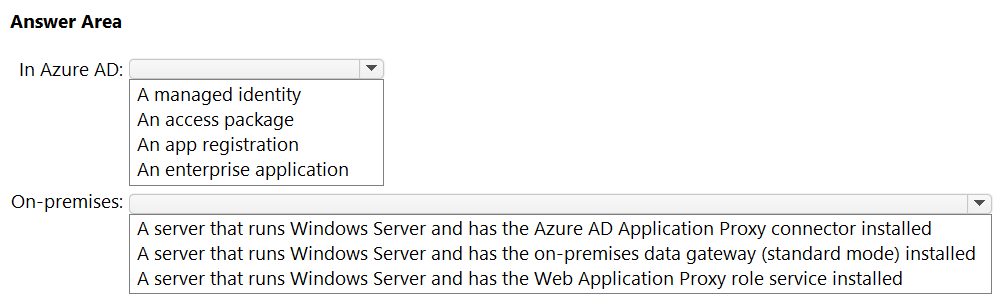
Correct Answer: 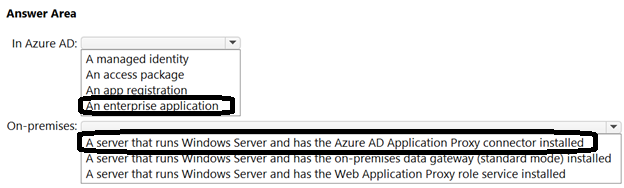
Question #113Topic 4
You have an Azure subscription that contains an Azure Kubernetes Service (AKS) instance named AKS1. AKS1 hosts microservice-based APIs that are configured to listen on non-default HTTP ports.
You plan to deploy a Standard tier Azure API Management instance named APIM1 that will make the APIs available to external users.
You need to ensure that the AKS1 APIs are accessible to APIM1. The solution must meet the following requirements:
• Implement MTLS authentication between APIM1 and AKS1.
• Minimize development effort.
• Minimize costs.
What should you do?
- A. Implement an external load balancer on AKS1.
- B. Redeploy APIM1 to the virtual network that contains AKS1.
- C. Implement an ExternalName service on AKS1.
- D. Deploy an ingress controller to AKS1.
Correct Answer: D
Community vote distribution
D (100%)
Question #114Topic 4
HOTSPOT
–
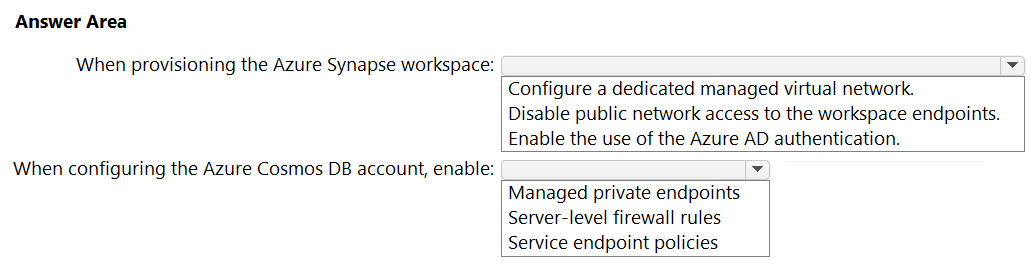
You need to recommend a solution to integrate Azure Cosmos DB and Azure Synapse. The solution must meet the following requirements:
• Traffic from an Azure Synapse workspace to the Azure Cosmos DB account must be sent via the Microsoft backbone network.
• Traffic from the Azure Synapse workspace to the Azure Cosmos DB account must NOT be routed over the internet.
• Implementation effort must be minimized.
What should you include in the recommendation? To answer, select the appropriate options in the answer area.
NOTE: Each correct selection is worth one point.
Correct Answer: 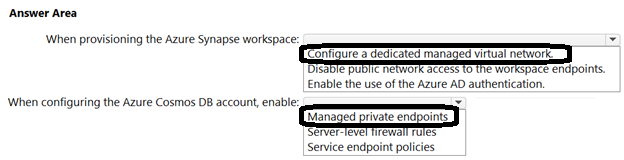
Topic 5 – Testlet 1
Question #1Topic 5
Introductory InfoCase Study –
This is a case study. Case studies are not timed separately. You can use as much exam time as you would like to complete each case. However, there may be additional case studies and sections on this exam. You must manage your time to ensure that you are able to complete all questions included on this exam in the time provided.
To answer the questions included in a case study, you will need to reference information that is provided in the case study. Case studies might contain exhibits and other resources that provide more information about the scenario that is described in the case study. Each question is independent of the other questions in this case study.
At the end of this case study, a review screen will appear. This screen allows you to review your answers and to make changes before you move to the next section of the exam. After you begin a new section, you cannot return to this section.
To start the case study –
To display the first question in this case study, click the Next button. Use the buttons in the left pane to explore the content of the case study before you answer the questions. Clicking these buttons displays information such as business requirements, existing environment, and problem statements. If the case study has an All Information tab, note that the information displayed is identical to the information displayed on the subsequent tabs When you are ready to answer a question, click the Question button to return to the question.
Overview –
Litware, Inc. is a medium-sized finance company that has a main office in Boston.
Existing Environment –
Identity Environment –
The network contains an Active Directory forest named litware.com that is linked to an Azure Active Directory (Azure AD) tenant named litware.com. All users have Azure Active Directory Premium P2 licenses.
Litware has a second Azure AD tenant named dev.litware.com that is used as a development environment.
The litware.com tenant has a Conditional Access policy named Capolicy1. Capolicy1 requires that when users manage the Azure subscription for a production environment by using the Azure portal, they must connect from a hybrid Azure AD-joined device.
Azure Environment –
Litware has 10 Azure subscriptions that are linked to the Litware.com tenant and five Azure subscriptions that are linked to the dev.litware.com tenant. All the subscriptions are in an Enterprise Agreement (EA).
The litware.com tenant contains a custom Azure role-based access control (Azure RBAC) role named Role1 that grants the DataActions read permission to the blobs and files in Azure Storage.
On-Premises Environment –
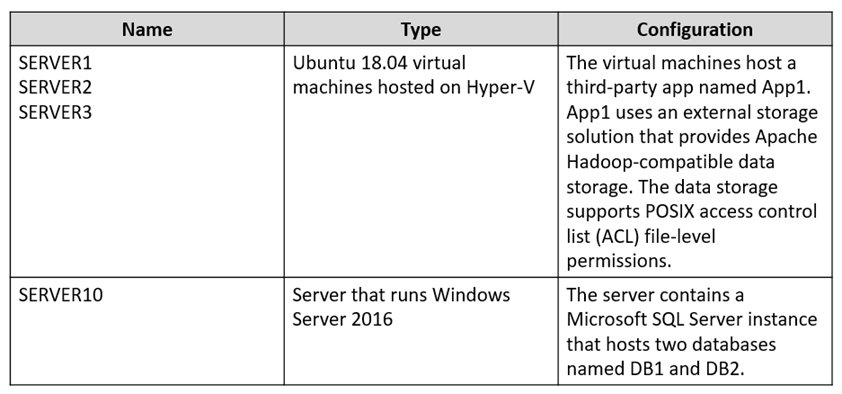
The on-premises network of Litware contains the resources shown in the following table.
Network Environment –
Litware has ExpressRoute connectivity to Azure.
Planned Changes and Requirements
Planned Changes –
Litware plans to implement the following changes:
Migrate DB1 and DB2 to Azure.
Migrate App1 to Azure virtual machines.
Migrate the external storage used by App1 to Azure Storage.
Deploy the Azure virtual machines that will host App1 to Azure dedicated hosts.

Authentication and Authorization Requirements
Litware identifies the following authentication and authorization requirements:
Only users that manage the production environment by using the Azure portal must connect from a hybrid Azure AD-joined device and authenticate by using
Azure Multi-Factor Authentication (MFA).
The Network Contributor built-in RBAC role must be used to grant permissions to the network administrators for all the virtual networks in all the Azure subscriptions.
To access the resources in Azure, App1 must use the managed identity of the virtual machines that will host the app.
RBAC roles must be applied to management groups.
Resiliency Requirements –
Litware identifies the following resiliency requirements:
Once migrated to Azure, DB1 and DB2 must meet the following requirements:
– Maintain availability if two availability zones in the local Azure region fail.
– Fail over automatically.
– Minimize I/O latency.
App1 must meet the following requirements:
– Be hosted in an Azure region that supports availability zones.
– Be hosted on Azure virtual machines that support automatic scaling.
– Maintain availability if two availability zones in the local Azure region fail.
Security and Compliance Requirements
Litware identifies the following security and compliance requirements:
Once App1 is migrated to Azure, you must ensure that new data can be written to the app, and the modification of new and existing data is prevented for a period of three years.
On-premises users and services must be able to access the Azure Storage account that will host the data in App1.
Access to the public endpoint of the Azure Storage account that will host the App1 data must be prevented.
All Azure SQL databases in the production environment must have Transparent Data Encryption (TDE) enabled.
App1 must NOT share physical hardware with other workloads.
Business Requirements –
Litware identifies the following business requirements:
Minimize administrative effort.
Minimize costs.
 QuestionHOTSPOT –
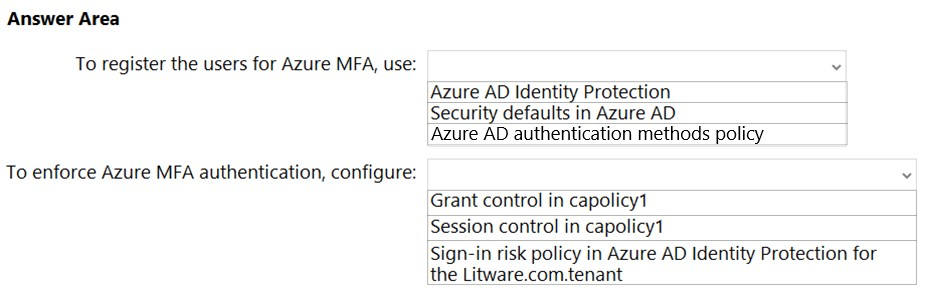
You need to ensure that users managing the production environment are registered for Azure MFA and must authenticate by using Azure MFA when they sign in to the Azure portal. The solution must meet the authentication and authorization requirements.
What should you do? To answer, select the appropriate options in the answer area.
NOTE: Each correct selection is worth one point.
Hot Area:
Correct Answer: 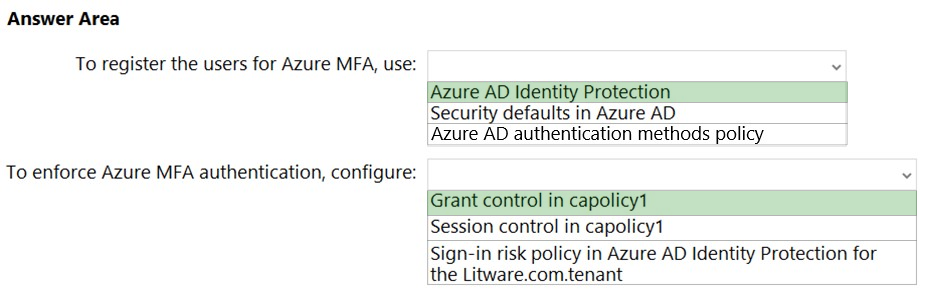
Box 1: Azure AD Identity Protection
Only users that manage the production environment by using the Azure portal must connect from a hybrid Azure AD-joined device and authenticate by using
Azure Multi-Factor Authentication (MFA).
Note: Policy configuration –
1. Navigate to the Azure portal.
2. Browse to Azure Active Directory > Security > Identity Protection > MFA registration policy.
3. Under Assignments
4. Users – Choose All users or Select individuals and groups if limiting your rollout.
5. Optionally you can choose to exclude users from the policy.
6. Enforce Policy – On
7. Save
Box 2: Grant control in capolicy1
The litware.com tenant has a Conditional Access policy named Capolicy1. Capolicy1 requires that when users manage the Azure subscription for a production environment by using the Azure portal, they must connect from a hybrid Azure AD-joined device.
Note: We need to configure the policy conditions for capolicy1 that prompt for MFA.
Reference:
https://docs.microsoft.com/en-us/azure/active-directory/identity-protection/howto-identity-protection-configure-mfa-policy https://docs.microsoft.com/en-us/azure/active-directory/authentication/tutorial-enable-azure-mfa
Question #2Topic 5
Introductory InfoCase Study –
This is a case study. Case studies are not timed separately. You can use as much exam time as you would like to complete each case. However, there may be additional case studies and sections on this exam. You must manage your time to ensure that you are able to complete all questions included on this exam in the time provided.
To answer the questions included in a case study, you will need to reference information that is provided in the case study. Case studies might contain exhibits and other resources that provide more information about the scenario that is described in the case study. Each question is independent of the other questions in this case study.
At the end of this case study, a review screen will appear. This screen allows you to review your answers and to make changes before you move to the next section of the exam. After you begin a new section, you cannot return to this section.
To start the case study –
To display the first question in this case study, click the Next button. Use the buttons in the left pane to explore the content of the case study before you answer the questions. Clicking these buttons displays information such as business requirements, existing environment, and problem statements. If the case study has an All Information tab, note that the information displayed is identical to the information displayed on the subsequent tabs When you are ready to answer a question, click the Question button to return to the question.
Overview –
Litware, Inc. is a medium-sized finance company that has a main office in Boston.
Existing Environment –
Identity Environment –
The network contains an Active Directory forest named litware.com that is linked to an Azure Active Directory (Azure AD) tenant named litware.com. All users have Azure Active Directory Premium P2 licenses.
Litware has a second Azure AD tenant named dev.litware.com that is used as a development environment.
The litware.com tenant has a Conditional Access policy named Capolicy1. Capolicy1 requires that when users manage the Azure subscription for a production environment by using the Azure portal, they must connect from a hybrid Azure AD-joined device.
Azure Environment –
Litware has 10 Azure subscriptions that are linked to the Litware.com tenant and five Azure subscriptions that are linked to the dev.litware.com tenant. All the subscriptions are in an Enterprise Agreement (EA).
The litware.com tenant contains a custom Azure role-based access control (Azure RBAC) role named Role1 that grants the DataActions read permission to the blobs and files in Azure Storage.
On-Premises Environment –
The on-premises network of Litware contains the resources shown in the following table.
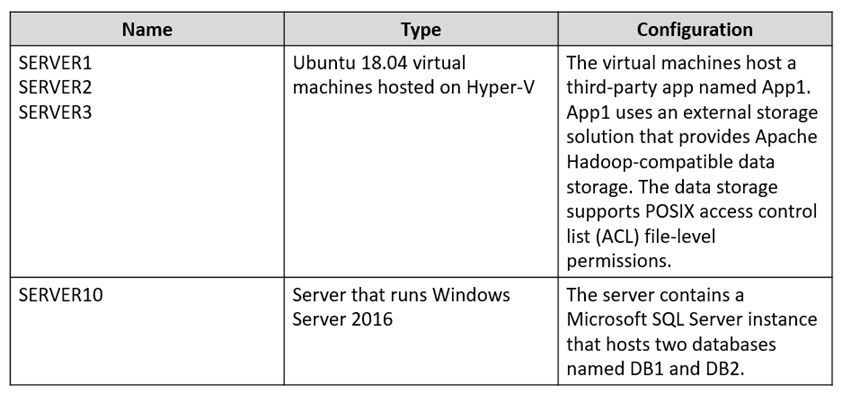
Network Environment –
Litware has ExpressRoute connectivity to Azure.
Planned Changes and Requirements
Planned Changes –
Litware plans to implement the following changes:
Migrate DB1 and DB2 to Azure.
Migrate App1 to Azure virtual machines.
Migrate the external storage used by App1 to Azure Storage.
Deploy the Azure virtual machines that will host App1 to Azure dedicated hosts.

Authentication and Authorization Requirements
Litware identifies the following authentication and authorization requirements:
Only users that manage the production environment by using the Azure portal must connect from a hybrid Azure AD-joined device and authenticate by using
Azure Multi-Factor Authentication (MFA).
The Network Contributor built-in RBAC role must be used to grant permissions to the network administrators for all the virtual networks in all the Azure subscriptions.
To access the resources in Azure, App1 must use the managed identity of the virtual machines that will host the app.
RBAC roles must be applied to management groups.
Resiliency Requirements –
Litware identifies the following resiliency requirements:
Once migrated to Azure, DB1 and DB2 must meet the following requirements:
– Maintain availability if two availability zones in the local Azure region fail.
– Fail over automatically.
– Minimize I/O latency.
App1 must meet the following requirements:
– Be hosted in an Azure region that supports availability zones.
– Be hosted on Azure virtual machines that support automatic scaling.
– Maintain availability if two availability zones in the local Azure region fail.
Security and Compliance Requirements
Litware identifies the following security and compliance requirements:
Once App1 is migrated to Azure, you must ensure that new data can be written to the app, and the modification of new and existing data is prevented for a period of three years.
On-premises users and services must be able to access the Azure Storage account that will host the data in App1.
Access to the public endpoint of the Azure Storage account that will host the App1 data must be prevented.
All Azure SQL databases in the production environment must have Transparent Data Encryption (TDE) enabled.
App1 must NOT share physical hardware with other workloads.
Business Requirements –
Litware identifies the following business requirements:
Minimize administrative effort.
Minimize costs.
 Question After you migrate App1 to Azure, you need to enforce the data modification requirements to meet the security and compliance requirements.
What should you do?
- A. Create an access policy for the blob service.
- B. Implement Azure resource locks.
- C. Create Azure RBAC assignments.
- D. Modify the access level of the blob service.
Correct Answer: A
Scenario: Once App1 is migrated to Azure, you must ensure that new data can be written to the app, and the modification of new and existing data is prevented for a period of three years.
As an administrator, you can lock a subscription, resource group, or resource to prevent other users in your organization from accidentally deleting or modifying critical resources. The lock overrides any permissions the user might have.
Reference:
https://docs.microsoft.com/en-us/azure/azure-resource-manager/management/lock-resources
Community vote distribution
A (91%)
